



Your first crypto trade: pairs, prices and what you’re buying
Trading Essentials Series 1 of 6
Follow a hypothetical $100 crypto purchase. Learn trading pairs, fractional coins, order fills and what changes when you sell.
Only put money into crypto that you can afford to lose in full. This guide is for education and is not personal financial advice. Do your own research into the asset, platform, fees and risks before making a decision.
Read the infographic as text
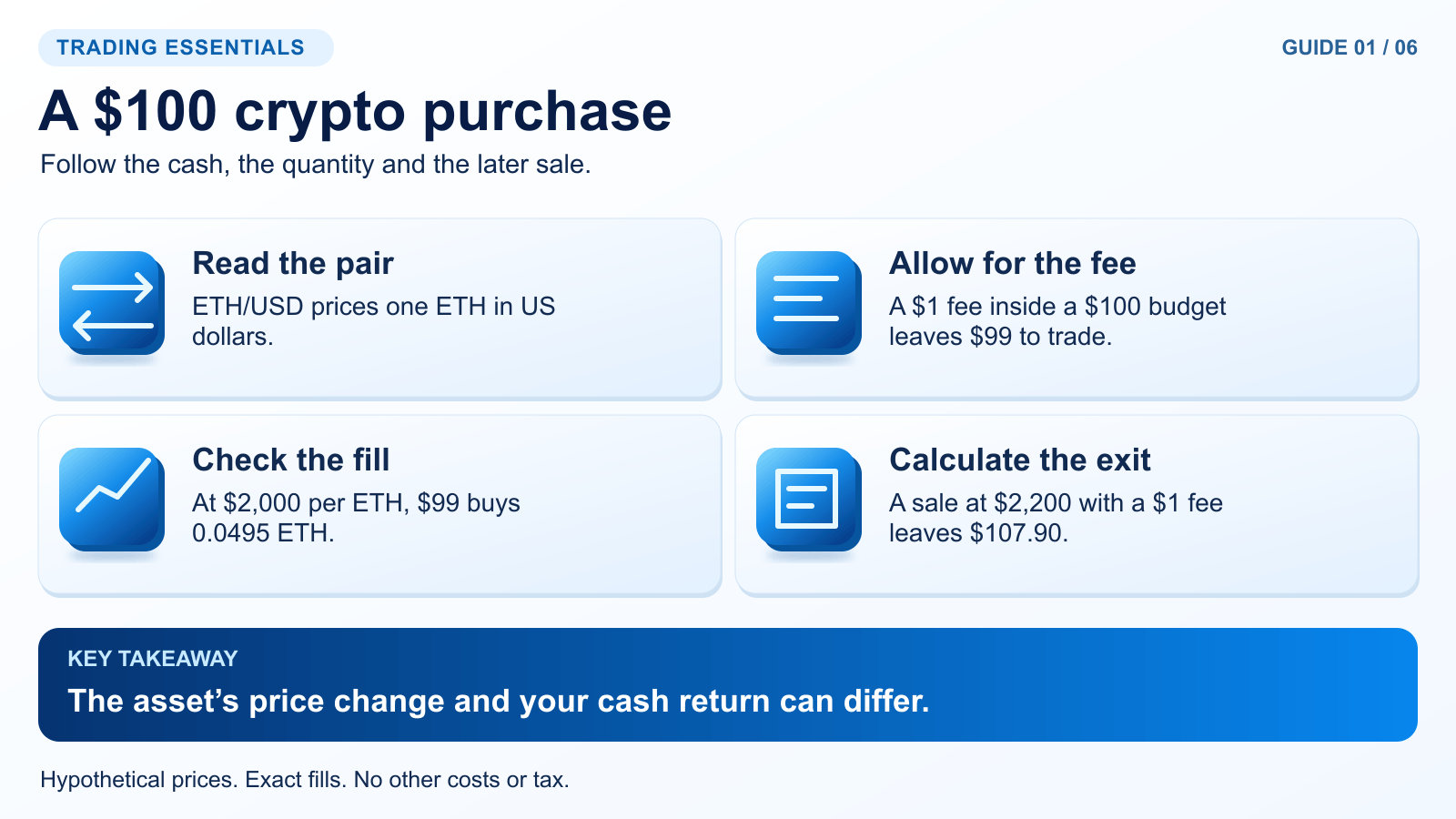
A $100 crypto purchase
Follow the cash, the quantity and the later sale.
- Read the pair
- ETH/USD prices one ETH in US dollars.
- Allow for the fee
- A $1 fee inside a $100 budget leaves $99 to trade.
- Check the fill
- At $2,000 per ETH, $99 buys 0.0495 ETH.
- Calculate the exit
- A sale at $2,200 with a $1 fee leaves $107.90.
Key takeaway: The asset’s price change and your cash return can differ.
Hypothetical prices. Exact fills. No other costs or tax.
View the worked example and calculation
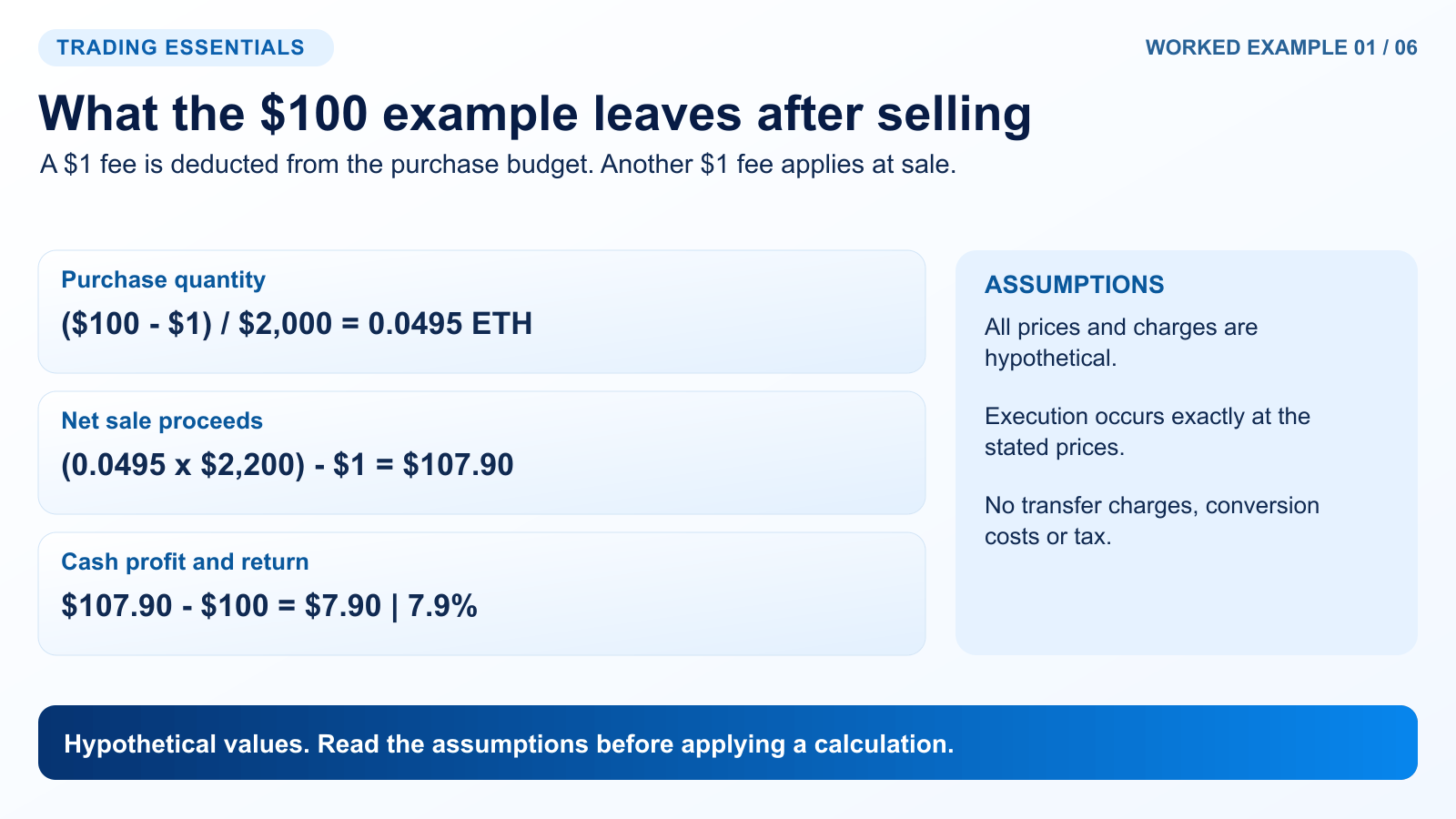
What the $100 example leaves after selling
A $1 fee is deducted from the purchase budget. Another $1 fee applies at sale.
- Purchase quantity
- ($100 - $1) / $2,000 = 0.0495 ETH
- Net sale proceeds
- (0.0495 x $2,200) - $1 = $107.90
- Cash profit and return
- $107.90 - $100 = $7.90 | 7.9%
All prices and charges are hypothetical.
Execution occurs exactly at the stated prices.
No transfer charges, conversion costs or tax.
Let’s suppose you want to spend $100 on ether, the asset used on Ethereum. Before pressing Buy, you need to know what that $100 buys, which currency the price is quoted in and how much of the asset will reach your account.
Read the pair before the price
An ETH/USD market quotes the price of one ether in US dollars. ETH is the base asset, the thing whose quantity you are buying or selling. USD is the quote currency, the unit used to price it. A buy uses dollars to acquire ETH. A sell exchanges ETH for dollars. If the displayed price were $2,000 per ETH, a $100 purchase would buy 0.05 ETH before costs. You can buy a fraction of a coin, subject to the platform’s minimum trade and quantity increments. You do not need the money for a whole unit. Kraken’s trading glossary explains the base and quote convention. Kraken trading glossary
All prices and fees in this guide are hypothetical. The dollar examples make the arithmetic easy to follow and do not imply a product is available in every country. The same calculation works in euros or another quote currency. ETH/USDC is a different pair from ETH/USD. With ETH/USDC, selling ETH gives you USDC, a token intended to track the US dollar. To get money into your bank account, you may still need another conversion. A stablecoin introduces its own issuer and redemption arrangements, explained in our guide to different forms of digital money.
Work out what the $100 actually covers
Suppose the provider takes a $1 fee from your $100 budget and executes the remaining $99 at exactly $2,000 per ETH. The quantity is 99 ÷ 2,000 = 0.0495 ETH. If it charges the fee on top instead, buying $100 worth costs $101 and gives you 0.05 ETH under the same assumptions. Read the preview for the total you pay and the quantity you receive. A small difference becomes material when you repeat the trade.
An instant buy screen may give you a firm quote valid for a short time. An order-book screen instead lets you send instructions to a market where buyers and sellers have orders waiting. The latest displayed trade is one execution that already happened. Your next order can meet a different price, depending on what is available when it arrives. A quote can include a spread, while an order-book trade may have a separate commission. Check the method your provider uses rather than adding the same cost twice. Coinbase describes these different execution arrangements in its policy. Coinbase order execution policy
A request becomes a trade only when it fills
A market order asks to trade against available orders, subject to the venue’s safeguards. A limit order adds a price condition. If your limit buy is below the prices sellers currently accept, it can wait without buying anything. An accepted order can also fill in several pieces, sometimes at several prices. The balance shown as available to spend may be smaller because an open order has reserved money. Check the order history for the amount executed and what remains open. Our guide to market, limit and stop orders follows those choices.
After a fill, the exchange usually updates its own account records. A purchase of ETH in an exchange account does not mean it sent ETH to an address whose keys you control. Establish what rights the product gives you and whether external withdrawals are supported before deciding where to hold it. A derivative contract or a listed security linked to ETH’s price has different terms from a spot purchase. The ownership guide explains how to distinguish them.
Selling changes the holding and reveals the result
Return to the 0.0495 ETH acquired for a total of $100. If you later sell all of it at $2,200, gross proceeds are 0.0495 × 2,200 = $108.90. With a hypothetical $1 selling fee, you receive $107.90. Your cash profit is $7.90 before any other costs or taxes. The price rose 10%, but your return on the $100 spent is 7.9%. This example assumes exact execution at both prices and no withdrawal, conversion or holding charges. The cost guide shows what changes when those assumptions stop holding.
Until you sell, the app may display an unrealised gain or loss using its chosen valuation price. That figure changes with the market and may exclude exit costs. After a sale, keep the actual execution record, the amount and currency of each fee, and the resulting balance. If you paid for the purchase in a different currency from the sale proceeds, a meaningful comparison also needs both amounts expressed in a consistent currency. Check your local rules on reporting trades, including swaps.
You can rehearse the sequence with a paper example. Choose a pair, write down a budget including costs, specify an order and then calculate what a later sale would leave. The point of the exercise is to recognise the instructions and balances before you have to interpret them in a live account.
Sources
Related reading
Guides ·
Why your crypto trade costs more than the advertised fee
Work through spreads, slippage, maker and taker fees, and the difference between a price move and the profit you actually keep.
Guides ·
Planning a crypto trade: position size, exits and keeping records
Use a hypothetical trade to calculate position size, allow for imperfect exits and record the result after costs.
Guides ·
Market, limit and stop orders explained
Understand how crypto order types control price and execution, why stops can slip and what a partial fill means for your balance.
Guides ·
Who owns your crypto? Private keys and custody explained
Find out what you own when you buy crypto, which products let you withdraw it and how private keys give you control of your own wallet.