



Stablecoins, tokenised deposits and CBDCs: how they differ
BlockBeat Guides
The issuer, legal claim and redemption route distinguish three forms of digital money. A shared currency label does not give them identical protections.
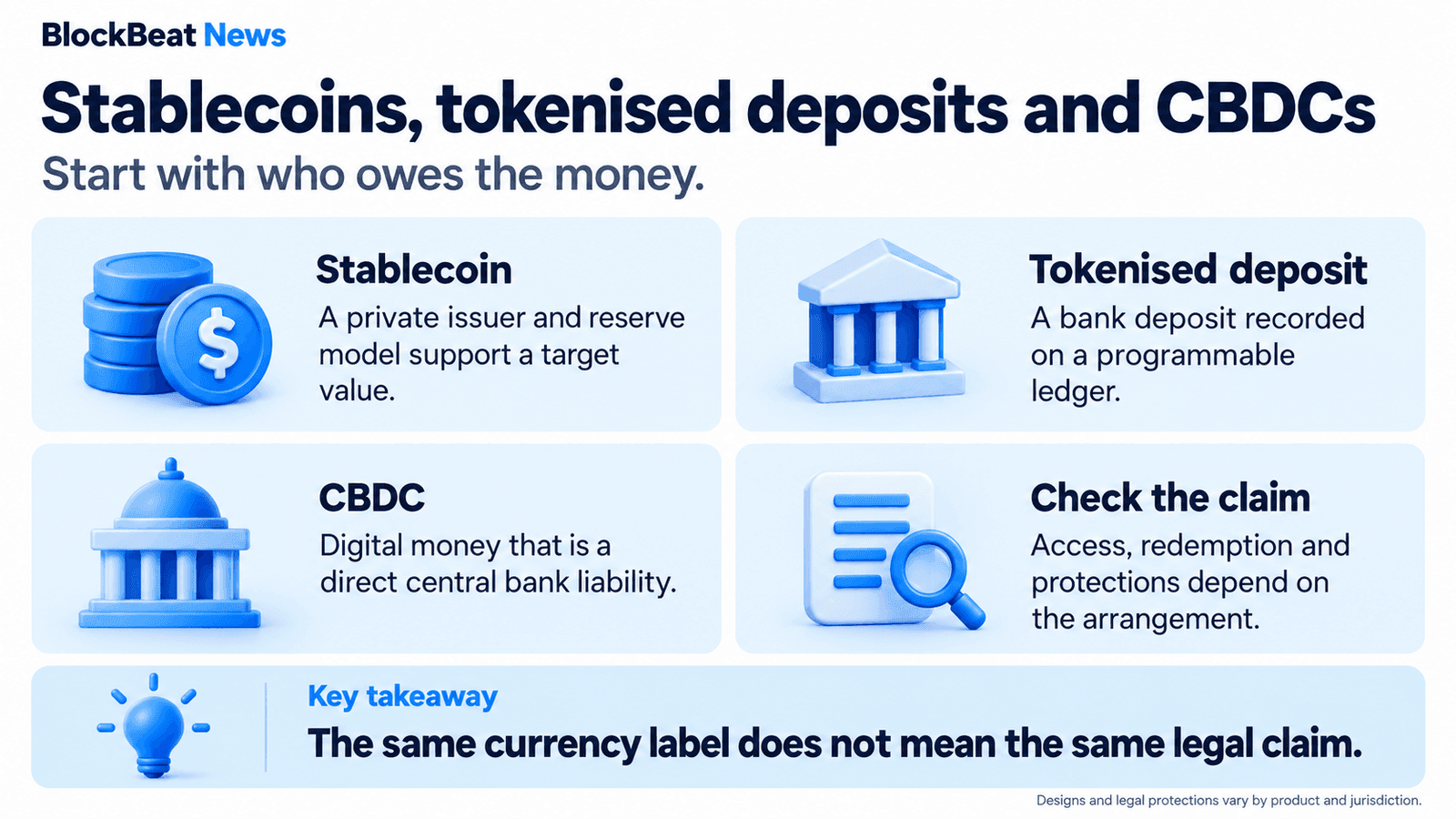
Read the infographic as text
Stablecoins, tokenised deposits and CBDCs
Start with who owes the money.
- Stablecoin
- A private issuer and reserve model support a target value.
- Tokenised deposit
- A bank deposit recorded on a programmable ledger.
- CBDC
- Digital money that is a direct central bank liability.
- Check the claim
- Access, redemption and protections depend on the arrangement.
Key takeaway: The same currency label does not mean the same legal claim.
Designs and legal protections vary by product and jurisdiction.
A stablecoin, a tokenised deposit and a central bank digital currency can all be denominated in the same currency while giving their holders different claims. To distinguish them, identify who owes the money and the terms on which the holder can use or exchange it.
The ledger is a separate choice. A blockchain can record several kinds of money, and a central bank digital currency does not have to use a public blockchain.
A stablecoin targets a reference value
For a fiat-backed stablecoin, a private issuer arranges reserves and redemption to support a target such as one US dollar. The holder's rights depend on the product documents and applicable law. Holding the token does not automatically mean owning a proportional slice of every reserve asset.
Access matters alongside backing. Circle's USDC terms make direct redemption conditional on eligibility and account arrangements. Someone holding USDC through a retail exchange may rely on that exchange to convert it into bank money. Other stablecoins have different structures, including mechanisms that do not rely on a conventional fiat reserve.
Our guide to stablecoin payments follows the conversion stages. The token's target price and the amount a particular customer receives after fees are separate facts.
A tokenised deposit remains a bank liability
A tokenised deposit represents commercial bank deposit money on a programmable ledger. The bank remains the debtor. Tokenisation changes how the deposit can be recorded or used; it does not turn the balance into central bank money.
The BIS analysis of stablecoins and tokenised deposits describes a model in which transfers between banks settle in central bank money, helping preserve exchange at par. That model should not be assumed for every product carrying the tokenised-deposit label.
Check which bank issues the deposit, who can hold it, how transfers between banks work and whether the recipient receives a claim on the same bank or another one. Deposit protection, where available, depends on the jurisdiction, depositor eligibility, product classification and statutory limits. A token format alone establishes none of those conditions.
A CBDC is a direct central bank liability
The BIS definition of CBDCs distinguishes retail money intended for public use from wholesale arrangements for eligible financial institutions. A wholesale settlement experiment is therefore different from a digital wallet available to every resident.
Central bank issuance changes the credit relationship. It does not remove operational, fraud, privacy or access questions. Distribution can involve private wallet providers, and choices about interest, holding limits and offline payments depend on the particular design.
The Bank of England's digital pound information describes an exploration of possible issuance rather than an existing retail product. A proposal, a pilot and a live currency need to be identified separately. Neither the digital pound's proposed features nor another jurisdiction's rules define all CBDCs.
Compare the same payment obligation
Imagine a business paying a £1,000 invoice using three hypothetical sterling products. A stablecoin route requires checking the issuer's redemption promise and the supplier's conversion route. A tokenised deposit requires checking the issuing bank and transfer arrangements. A retail CBDC, where actually available, requires checking eligibility and the wallet service through which the supplier receives it.
In each case, establish when the invoice is legally discharged and when the supplier can use the funds. The decisive distinction is the chain of claims and obligations, followed by the practical route to payment.
Sources
Related reading
Commentary ·
DeFi’s dependence on stablecoins concentrates liquidity and control
Stablecoins are evolving from trading instruments into core liquidity infrastructure underpinning decentralised finance, payments, and tokenised markets.
Guides ·
SWIFT versus blockchain payments: what is actually being compared?
Messaging, settlement assets and the recipient's access to money are different layers. Compare a complete payment route before judging cost or speed.
Intelligence ·
Banks bring stablecoins and DeFi settlement into financial services
Stablecoins, tokenised assets, institutional lending and blockchain settlement are beginning to converge with traditional finance, suggesting DeFi's next phase could be far less visible than its first.
Intelligence ·
DeFi lending and settlement connect tokenised assets to capital markets
Tokenised equities, funds and private-market instruments are increasingly connecting to DeFi lending, collateral and settlement infrastructure. The shift expands DeFi’s addressable market, but also places greater weight on stablecoin concentration, issuer controls and institutional risk standards.