



SWIFT versus blockchain payments: what is actually being compared?
BlockBeat Guides
Messaging, settlement assets and the recipient's access to money are different layers. Compare a complete payment route before judging cost or speed.
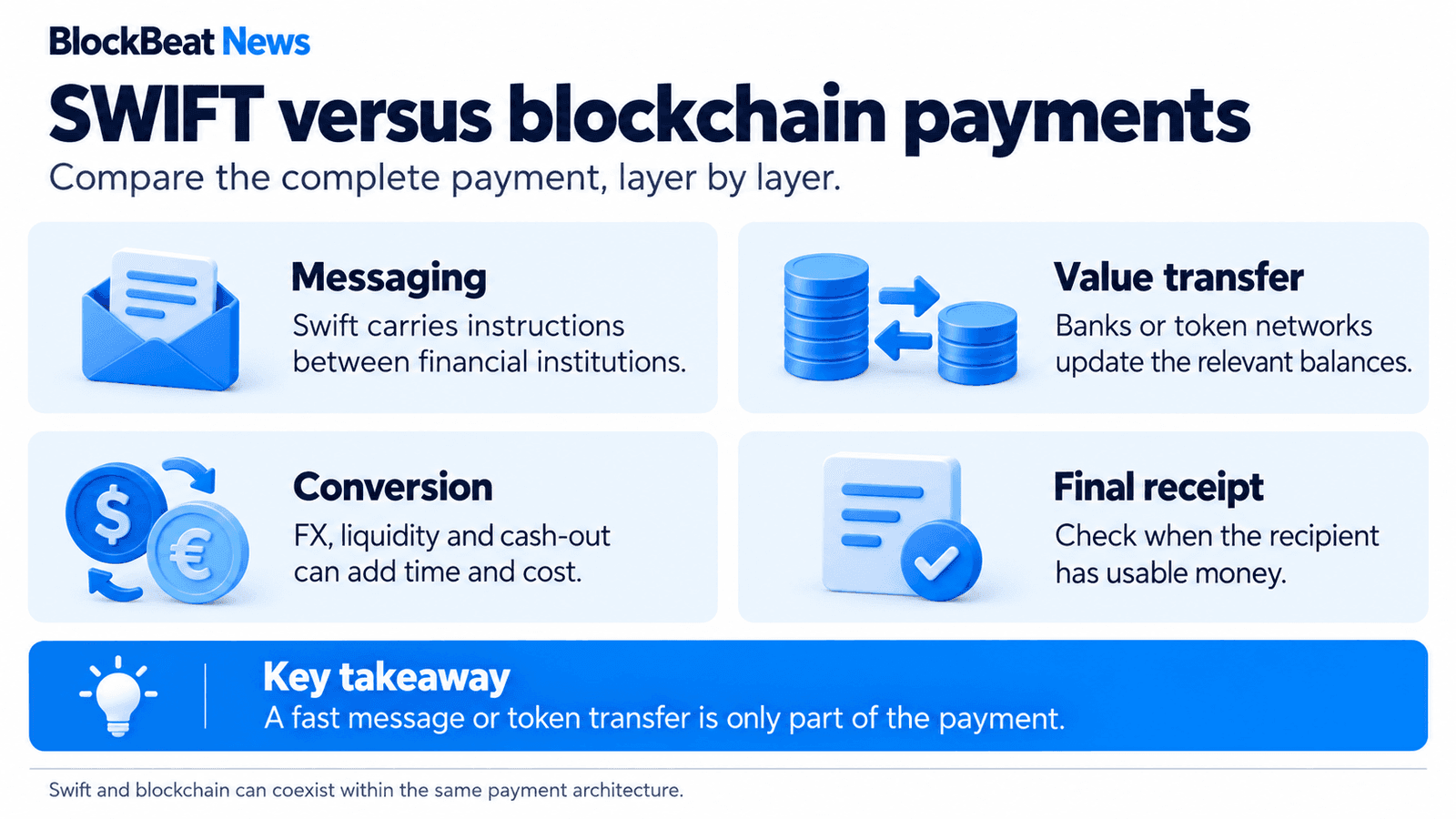
Read the infographic as text
SWIFT versus blockchain payments
Compare the complete payment, layer by layer.
- Messaging
- Swift carries instructions between financial institutions.
- Value transfer
- Banks or token networks update the relevant balances.
- Conversion
- FX, liquidity and cash-out can add time and cost.
- Final receipt
- Check when the recipient has usable money.
Key takeaway: A fast message or token transfer is only part of the payment.
Swift and blockchain can coexist within the same payment architecture.
Comparing a Swift message with a blockchain transfer can compare different parts of a payment. A useful assessment follows the same amount, currency pair and recipient requirement through the complete journey.
A transfer that ends with a dollar token in a wallet has a different endpoint from one that ends with spendable local currency in a bank account. Either can be useful, but their headline times and fees are not directly interchangeable.
Messaging instructs institutions to act
Swift describes its network as secure communication between financial institutions. Its established messaging service carries payment instructions and related information. The participating institutions and relevant payment systems make the corresponding balance changes.
The Federal Reserve's oversight explanation distinguishes Swift's messaging role from a payment or settlement system. In a correspondent-banking route, banks use account relationships, intermediaries where required and domestic payment infrastructure to complete the payment. A message arriving is different from the beneficiary being credited.
That distinction also prevents a misleading generalisation: every cross-border bank payment does not follow the same route or take the same time. Currency, counterparties, operating hours and compliance handling affect the result.
A blockchain moves a particular asset
A blockchain transaction updates ownership or balances under the network's rules. The asset might be a volatile cryptocurrency, a stablecoin or a permissioned bank token. Each creates a different exposure for the recipient.
For a stablecoin payment, the sender may first purchase tokens and the recipient may later sell them. Providers supply liquidity, currency conversion and access to local banking. Our guide to how stablecoin payments work shows why the network fee can be a small part of the complete cost.
Network confirmation establishes something about the ledger transaction. Legal settlement finality, discharge of the underlying invoice and access to bank money require examination of the surrounding arrangements. A fast token transfer does not establish all three.
Swift and blockchain can share an architecture
The categories increasingly overlap. Swift announced a blockchain-based shared ledger in 2025. In August 2026, Standard Chartered reported a first live cross-border transaction with HSBC on that ledger, using tokenised deposits. The bank described the ledger as an orchestration layer matching and netting obligations before final settlement through existing systems.
That is evidence of a specified live transaction and developing infrastructure. It does not establish universal availability, measured savings across all corridors or the replacement of Swift's existing messaging network. It does show why treating an institution and a technology as mutually exclusive alternatives obscures the actual design.
The useful comparison names the service, the settlement asset and the participating institutions. Our guide to stablecoins, tokenised deposits and CBDCs explains the different claims those assets can represent.
Hold the endpoint constant
Consider a hypothetical UK business paying a supplier that needs euros in a bank account. Request the same sender outlay and compare the final euros credited, including exchange-rate margins, service charges, network fees and cash-out costs.
Measure time from the business releasing funds to the supplier being able to spend them. Record any prefunding requirement, transfer limits and who handles an error. A continuously operating network can still connect to a provider with restricted banking hours.
If both businesses already hold and accept the same token, conversion may be unnecessary. Assess that route on its own terms. The choice should follow the required asset, final availability and recovery arrangements, with the infrastructure serving that requirement.
Sources
Related reading
Commentary ·
XRP versus SWIFT in Japan: what determines the cost of settlement?
Claims that XRP is cheaper than SWIFT in Japan reflect a deeper shift in cross-border payments, where settlement speed, liquidity design, and infrastructure control are redefining cost and competitive advantage.
Intelligence ·
Polygon licences and Samsung Wallet plans widen stablecoin distribution
Stablecoins and tokenised assets are moving beyond blockchain-native venues into licensed payment networks, mobile wallets and institutional products. The emerging competitive advantage is distribution and regulatory access, although security and asset integrity remain material constraints.
Intelligence ·
Banks bring stablecoins and DeFi settlement into financial services
Stablecoins, tokenised assets, institutional lending and blockchain settlement are beginning to converge with traditional finance, suggesting DeFi's next phase could be far less visible than its first.
Intelligence ·
Tokenised bonds and bank deposits move into operating financial products
Tokenised deposits, bonds, private assets and stablecoin payments are moving into operational financial products. Adoption is splitting between institutionally controlled settlement infrastructure and consumer-facing stablecoin services, while security and liquidity risks remain unresolved.