



How stablecoin payments work — and where the costs remain
BlockBeat Guides
A blockchain transfer is one stage of a payment. Conversion, redemption and local banking determine what the recipient can actually spend and when.
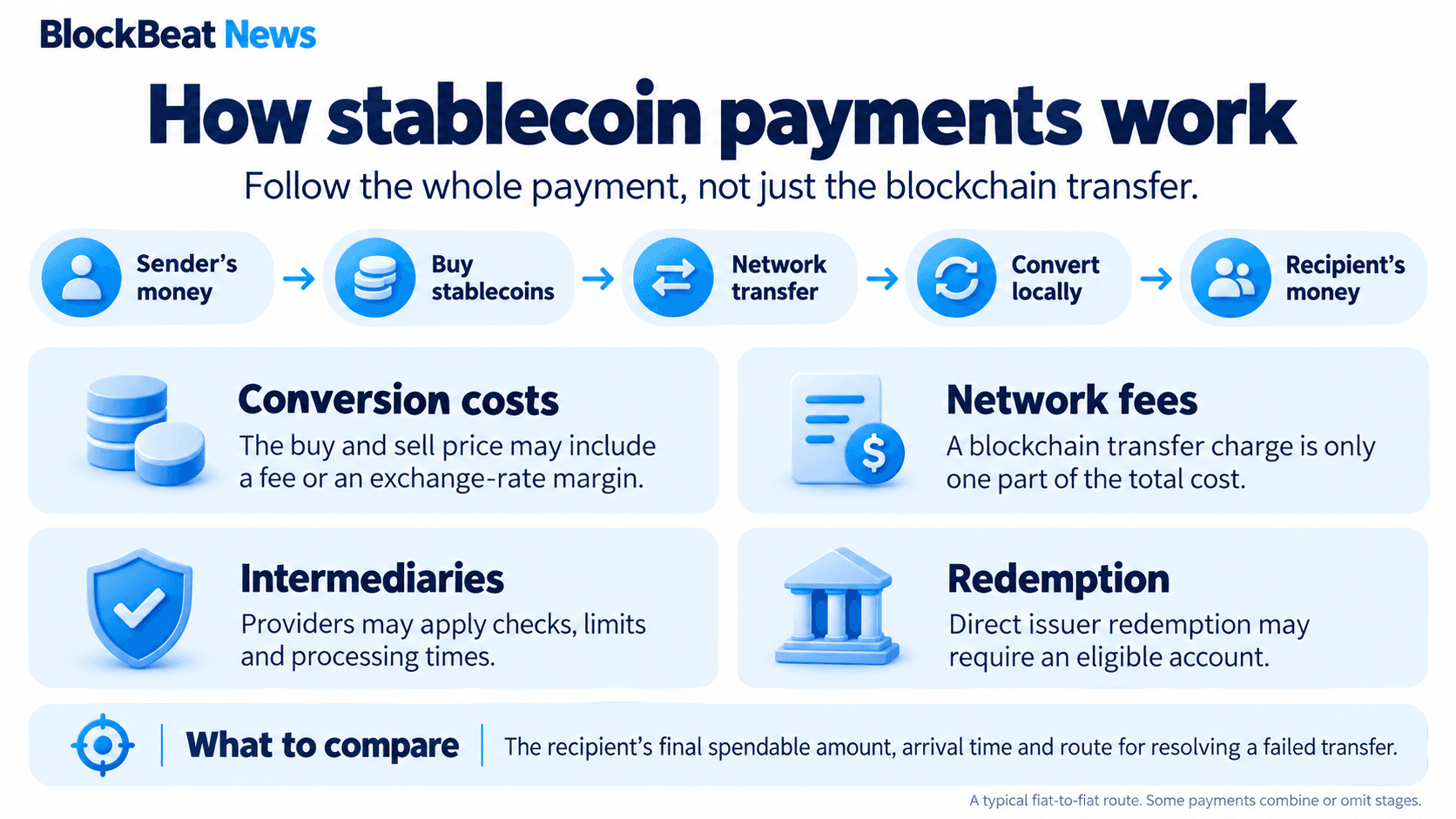
Read the infographic as text
How stablecoin payments work
Follow the whole payment, not just the blockchain transfer.
Sender’s money → Buy stablecoins → Network transfer → Convert locally → Recipient’s money.
- Conversion costs
- The buy and sell price may include a fee or an exchange-rate margin.
- Network fees
- A blockchain transfer charge is only one part of the total cost.
- Intermediaries
- Providers may apply checks, limits and processing times.
- Redemption
- Direct issuer redemption may require an eligible account.
What to compare: The recipient’s final spendable amount, arrival time and route for resolving a failed transfer.
A typical fiat-to-fiat route. Some payments combine or omit stages.
A stablecoin can cross a blockchain quickly while the person receiving it still waits for spendable money. The gap comes from the stages around the transfer: buying the token, meeting compliance checks, converting it into local currency and reaching a bank account or cash-out provider.
If the sender already holds the stablecoin and the recipient accepts it on the same network, neither buying tokens nor converting them back into local currency is necessary for that payment. For a family receiving a remittance in local currency, those conversion stages may account for most of the experience. Both arrangements are stablecoin payments, but they involve different services.
Follow the money from sender to recipient
In a common fiat-to-fiat route, a sender pays local currency to a provider, receives a fiat-backed stablecoin, transfers it on a supported network and has the recipient or a local provider convert it into the destination currency. Each provider applies its own access, pricing and compliance arrangements.
The token aims to track a reference value, often one US dollar. That target does not make every transaction occur exactly at par. Exchange spreads, fees, demand for local access and doubts about redemption can affect what someone pays or receives.
Circle’s USDC terms make direct redemption conditional on eligibility and a registered Circle Mint account. Its Circle Mint product description says the service is for qualifying distributors rather than retail personal use. A retail holder may therefore depend on an exchange or payment provider to cash out. Other issuers and jurisdictions have different arrangements.
A cheap network transfer can sit inside an expensive payment
Consider a hypothetical transfer that starts with £1,000. Buying tokens costs £4, network and service charges total £1, and the recipient’s conversion costs £10. A further £5 is lost through an exchange-rate margin relative to the comparison rate. The total cost is £20, or 2%, even though only £1 appears as the transfer charge. These are invented figures to illustrate the calculation, not a quote from a provider.
The useful comparison holds the sender’s outlay constant and measures the local currency the recipient can actually use. Include explicit charges, embedded exchange-rate margins and any withdrawal fee. Compare quotations at similar times because currency prices move.
An advertised “zero fee” can still involve a spread. Conversely, a visible service fee may be acceptable if the final amount and reliability are better. Payment rails should be compared on the full transaction rather than the cheapest individual stage.
Evidence from an end-to-end test
In a 2026 mystery-shopping exercise, Banca d’Italia tested USDC remittance routes from Italy. For its transfers of 200 USDC across ten corridors, it reported costs ranging from 0.30% to almost 9%. Blockchain charges were a minor component; conversion and access to local payment services were central frictions.
The exercise reported completion in under 20 minutes where instant payment systems were available, compared with one or two business days where standard bank transfers were needed. Those findings describe the tested routes and transaction size, rather than a universal price or speed for stablecoins.
Settlement, access and recoverability are separate questions
An on-chain confirmation records a transaction according to that network’s rules. It does not prove that a bank has credited the recipient or that a provider has completed its checks. A sender needs to know what the provider means by “settled”.
Network compatibility also matters. A token with a familiar ticker can exist on several chains or through a bridge. Sending on an unsupported network can leave the recipient unable to access it through their chosen service. Recovery arrangements vary; a wallet address alone does not establish compatibility.
A fiat-backed token additionally depends on its issuer, reserve arrangements and redemption process. An intermediary introduces its own operational and counterparty exposure. These dependencies are different from the network’s ability to process a valid transfer.
Moving the same token into a lending or trading pool adds another layer of exposure. Our guide to where DeFi yields come from separates the income from the additional risks.
Where stablecoins can earn their place
They can be useful when both parties want to hold and reuse the token, when banking hours interrupt an otherwise viable transaction, or when a particular route offers better access than existing services. A recipient who needs local cash immediately may care much more about the final conversion point.
Our Commentary on stablecoins and correspondent banking considers how those dependencies affect the wider payments business.
For the next provider comparison, request three concrete answers: the recipient’s final spendable amount, the time by which it should arrive and who handles a failed transfer. Those reveal more than the blockchain fee on its own.
Related reading
Guides ·
SWIFT versus blockchain payments: what is actually being compared?
Messaging, settlement assets and the recipient's access to money are different layers. Compare a complete payment route before judging cost or speed.
Intelligence ·
Polygon licences and Samsung Wallet plans widen stablecoin distribution
Stablecoins and tokenised assets are moving beyond blockchain-native venues into licensed payment networks, mobile wallets and institutional products. The emerging competitive advantage is distribution and regulatory access, although security and asset integrity remain material constraints.
Intelligence ·
Tokenised bonds and bank deposits move into operating financial products
Tokenised deposits, bonds, private assets and stablecoin payments are moving into operational financial products. Adoption is splitting between institutionally controlled settlement infrastructure and consumer-facing stablecoin services, while security and liquidity risks remain unresolved.
Commentary ·
XRP versus SWIFT in Japan: what determines the cost of settlement?
Claims that XRP is cheaper than SWIFT in Japan reflect a deeper shift in cross-border payments, where settlement speed, liquidity design, and infrastructure control are redefining cost and competitive advantage.