



Where DeFi yields come from — and who bears the risk
BlockBeat Guides
Borrowing interest, trading fees and token incentives pay for different things. Following the source of a return reveals the risks that a headline annual percentage can conceal.
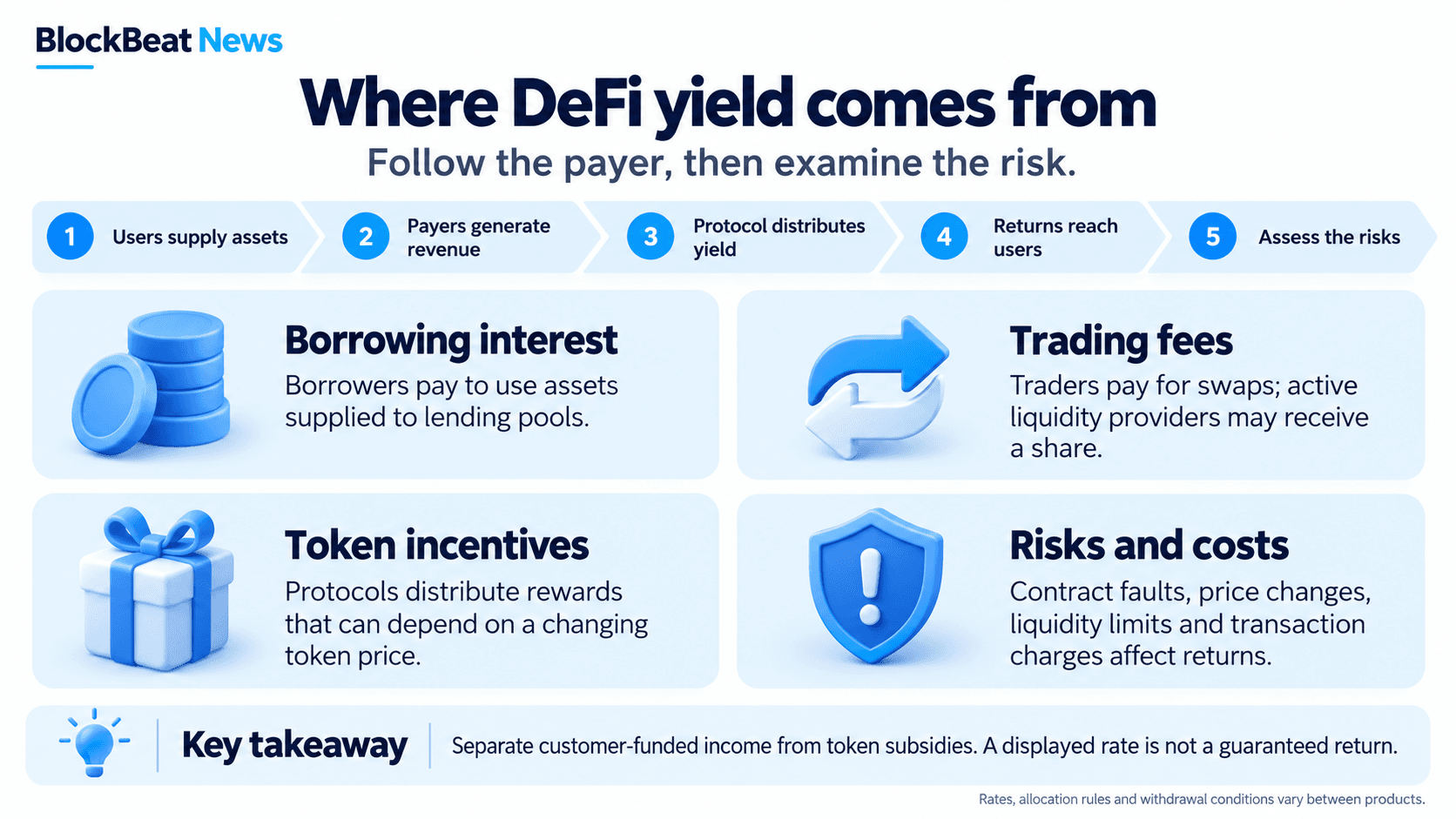
Read the infographic as text
Where DeFi yield comes from
Follow the payer, then examine the risk.
- Borrowing interest
- Borrowers pay to use assets supplied to lending pools.
- Trading fees
- Traders pay for swaps; active liquidity providers may receive a share.
- Token incentives
- Protocols distribute rewards that can depend on a changing token price.
- Risks and costs
- Contract faults, price changes, liquidity limits and transaction charges affect returns.
Key takeaway: Separate customer-funded income from token subsidies. A displayed rate is not a guaranteed return.
Rates, allocation rules and withdrawal conditions vary between products.
A DeFi yield needs someone or something to fund it. Borrowers can pay interest, traders can pay fees, and a protocol can distribute tokens as an incentive. A headline percentage can combine these sources even though their economics and risks differ.
Before comparing rates, follow the payment. Who pays it, which asset carries it, how is it calculated and what happens when the activity supporting it declines?
Borrowers pay for access to assets
In a lending pool, suppliers make assets available and borrowers pay to use them. The supplier’s return depends on the amount borrowed, the applicable interest model and the protocol’s deductions and allocation rules. Unborrowed liquidity does not earn the same borrower-funded income merely by existing in the pool.
Aave explains how utilisation and governance parameters affect supply interest rates. That is a description of its lending mechanism, rather than a fixed rate or a promise that suppliers can always withdraw immediately.
For a simplified hypothetical pool, imagine £100,000 supplied, £60,000 borrowed and borrowers paying 8% annually. Ignoring changing balances, compounding and other charges, gross annual interest would be £4,800. If 10% of that interest were retained, £4,320 would remain for suppliers: 4.32% of the supplied amount. Every figure here is invented to explain the arithmetic.
Actual pools can change rates continuously, and their accounting differs. The example shows why an 8% borrowing rate does not automatically mean an 8% supplier return.
Trading fees compensate liquidity providers
A decentralised exchange needs assets available for users to swap. Liquidity providers can earn a share of the fees generated by those swaps. Their receipts depend on trading activity, applicable fees and how much active liquidity competes for them.
Uniswap’s explanation of liquidity-provider fees describes fee allocation and the importance of an active position. The relevant rules differ between versions and pools; quoting one fee tier as a universal supplier return would be misleading.
Fee income is only one part of the outcome. As relative token prices move, the pool changes the mixture of assets held by a position. Its value can end below the value of simply holding the starting tokens, a difference often called impermanent loss. Uniswap’s protocol glossary defines that comparison.
That name does not mean the loss is harmless or certain to reverse. Fees may offset the difference, but they may not. A liquidity position can earn trading income while producing an unfavourable overall result.
Staking and strategies add other sources
Some DeFi products pass through staking rewards or combine lending, trading, hedging and other activities in a managed strategy. A single displayed rate can therefore aggregate several sources of return and several dependencies.
Ethereum's explanation of staking rewards and penalties describes rewards for participating in network validation. These include newly issued ETH; block proposers can also receive transaction fees and other execution-related income. Downtime penalties and slashing can reduce returns. This is payment for a network role, with different economics from a promotional reward programme.
A liquid staking token or a vault may pass that return to its holders while adding smart-contract, operator, market-price or withdrawal risks. Ethereum's staking documentation distinguishes the underlying validator rewards from the third-party arrangements used to access them. Each additional layer needs its own explanation of who pays, who controls the assets and how the holder exits.
Token incentives are a separate source of return
A protocol may distribute reward tokens to attract users. Those tokens have a market value, but their issuance is different from fees paid by customers or interest paid by borrowers.
Newly minted incentives expand the token supply and can dilute existing holders. Rewards paid from a treasury can instead redistribute tokens already in circulation. In either case, the token distribution should be identified separately from income paid by customers; a high advertised rate alone does not establish whether the arrangement is sustainable.
Imagine £100 of lending income alongside rewards advertised as another £300 at the current token price. If the reward token’s price halves before sale, those tokens might realise £150 instead. That changes the realised return even if the protocol delivered exactly the promised token quantity. This is an illustrative calculation, excluding costs and any movement in the supplied asset.
Ask where the rewards originate, how long the programme lasts, whether they vest and who might buy them. A temporary incentive can be commercially deliberate without being a permanent source of yield. Treating it as recurring operating revenue hides the dependency.
Annualisation can make a short period look durable
APR expresses a rate on an annual basis; APY usually incorporates compounding assumptions. Neither establishes that a variable rate will remain available for a year. A displayed yield may also omit transaction costs, rebalancing, claim fees or withdrawal conditions.
Read the denomination carefully. Earning more units of a token can coexist with losing value in pounds. Stablecoins aim to track a reference value, but the conversion and redemption dependencies described in our guide to stablecoin payments still matter.
The supplier accepts more than a price risk
Smart-contract faults, compromised administration, unreliable price data and limited exit liquidity can all affect the result. Counterparty exposure, leverage and token-price risk may be bundled into the same position. In lending, collateral liquidation is part of protecting the pool, but severe movements can still challenge that protection. Our guide to liquidations and forced selling follows the mechanism.
A useful yield comparison separates borrower interest, trading income, staking rewards and incentives, then subtracts realistic costs and examines the exit. Where a strategy combines them, follow each source separately. The strongest explanation of a return identifies both its payer and the person left carrying the loss if the arrangement fails.
Related reading
Commentary ·
DeFi’s dependence on stablecoins concentrates liquidity and control
Stablecoins are evolving from trading instruments into core liquidity infrastructure underpinning decentralised finance, payments, and tokenised markets.
Intelligence ·
Papertrade losses expose the risks behind leveraged DeFi volume
New 1,000x perpetual products generated substantial notional activity, but Papertrade’s reported $32.4 million of trader losses and subsequent controls show why volume is a weak proxy for durable demand. Evidence from Uniswap liquidity providers and PancakeSwap’s proposed economic overhaul points to a broader focus on net returns rather than headline activity.
Intelligence ·
Morpho and Kraken expand borrowing against tokenised stocks
In the 30 days to 22 September, tokenised equities, funds and other real-world assets moved beyond issuance into borrowing, yield and collateral products. The shift deepens institutional use of DeFi infrastructure, but stressed redemptions and high-LTV lending show that onchain distribution does not remove underlying credit, liquidity or governance risk.
Guides ·
How tokenised assets become collateral in DeFi
A lending protocol needs more than an asset token. Legal rights, transfer permissions, valuation and a workable recovery route determine whether it can support a loan.