



How tokenised assets become collateral in DeFi
BlockBeat Guides
A lending protocol needs more than an asset token. Legal rights, transfer permissions, valuation and a workable recovery route determine whether it can support a loan.
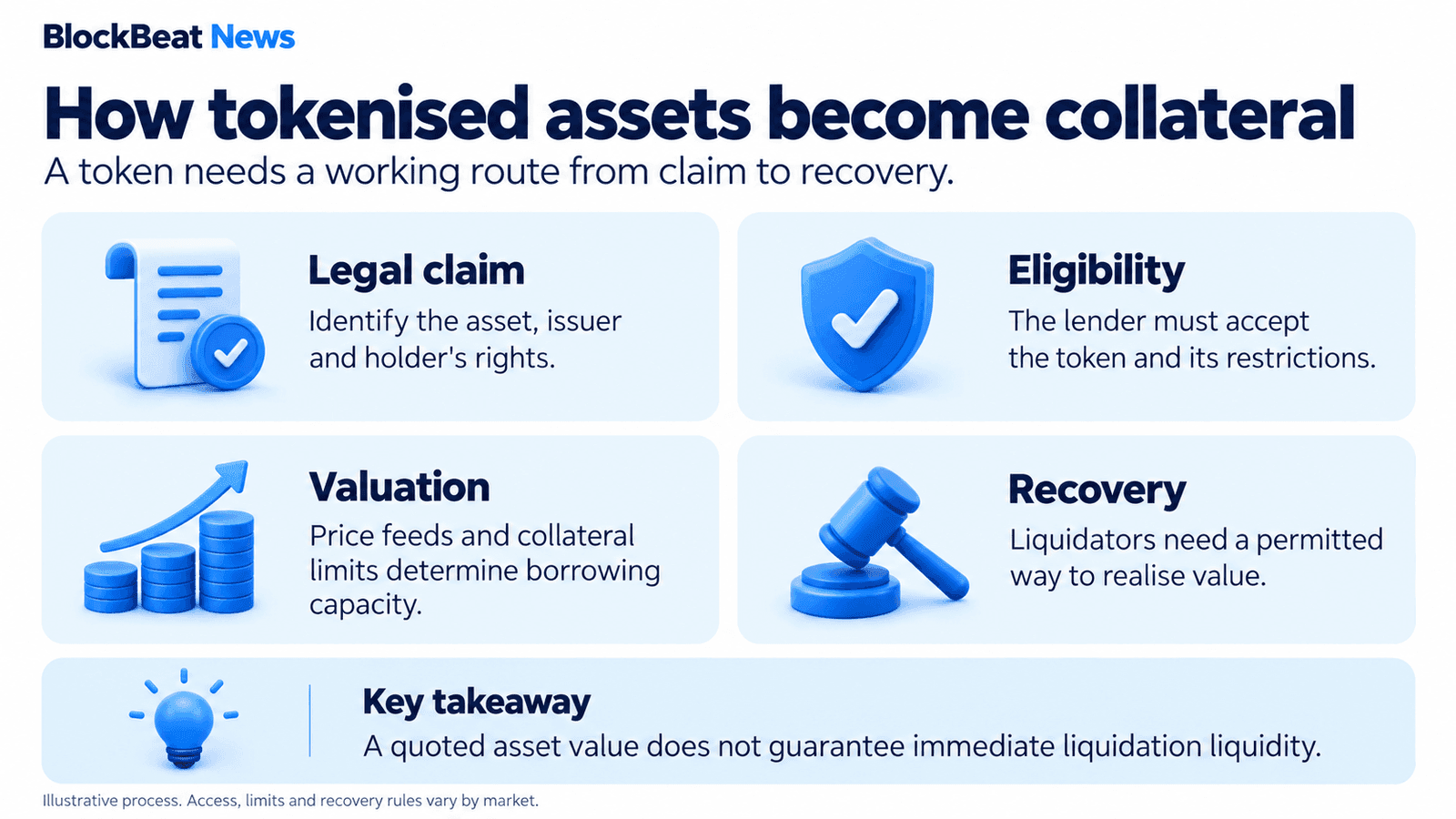
Read the infographic as text
How tokenised assets become collateral
A token needs a working route from claim to recovery.
- Legal claim
- Identify the asset, issuer and holder's rights.
- Eligibility
- The lender must accept the token and its restrictions.
- Valuation
- Price feeds and collateral limits determine borrowing capacity.
- Recovery
- Liquidators need a permitted way to realise value.
Key takeaway: A quoted asset value does not guarantee immediate liquidation liquidity.
Illustrative process. Access, limits and recovery rules vary by market.
A tokenised asset becomes useful collateral when a lender can value the claim, control it under the lending arrangement and recover value if the borrower fails to repay. Putting an asset on a blockchain does not complete those steps.
A token representing a fund interest, bond or property-related claim can carry restrictions that ordinary crypto collateral does not. Those restrictions matter most when a position needs to be transferred or liquidated quickly.
Establish what the token represents
Identify the issuer, governing documents, underlying asset and holder's rights. A token might represent a security directly, an interest held through an intermediary or contractual exposure. Our guide to what a tokenised share represents explains why the ticker does not establish ownership.
The SEC staff statement on tokenised securities distinguishes issuer-sponsored and third-party structures. It is US staff guidance, rather than a universal legal classification. A collateral review must establish the actual claim and applicable jurisdiction.
Depositing a token into a contract does not itself prove that a lender has an enforceable security interest over every underlying asset. Custody, insolvency treatment and the route from the token to off-chain recovery require their own documentation.
The market must accept the token and its holders
Lending markets decide which collateral they support and on what terms. Smart contracts must integrate the token, and access controls must permit the relevant borrower, custody contract and recovery participants to perform their roles.
Aave Horizon's documentation describes a separate market where qualified, allowlisted participants supply permissioned tokenised assets and borrow stablecoins. It illustrates how restricted collateral can connect with more open liquidity without making the collateral itself freely transferable to everyone.
Do not infer that an asset accepted in one market is accepted throughout DeFi. The contract address, network, issuer permissions and market configuration all matter. A wrapped representation can add another custodian or contractual layer.
Valuation determines borrowing capacity
The lending market needs an oracle or other valuation mechanism and a limit on how much debt the collateral supports. A published fund net asset value can be useful, but its update schedule and realisable exit value may differ from those of a continuously traded token.
Consider invented inputs: collateral valued at £100,000, a 60% borrowing limit and a 75% liquidation threshold. The borrowing limit would permit up to £60,000 of initial debt. With £50,000 borrowed, a simplified health factor would be £100,000 multiplied by 75%, divided by £50,000, or 1.5.
If the assessed collateral value fell to £65,000, that ratio would become 0.975 before interest or other changes. Aave's health-factor explanation describes eligibility for liquidation below 1. These figures are illustrative, not current Horizon terms or a recommended borrowing level. Borrowing limits and liquidation thresholds serve different purposes.
Liquidation needs a buyer or redemption route
A liquidator may repay eligible debt and receive collateral under the market's rules. For a restricted token, the recipient must be permitted to hold or redeem it. The underlying issuer may apply dealing windows, minimum sizes, settlement delays or suspension provisions.
An on-chain transfer can finish while an off-chain redemption remains pending. During that gap, a liquidator needs funding and bears price or operational exposure. Thin secondary liquidity can make the available sale price worse than the last reported asset value.
That timing mismatch is central to risk assessment. Our guide to liquidations and forced selling explains the transmission into market pressure. Before treating a token as dependable collateral, follow a stressed loan all the way to cash recovery: who receives the token, who can redeem it, how long it takes and who absorbs a shortfall.
Sources
Related reading
Intelligence ·
Aave and Morpho bring tokenised stocks into DeFi collateral markets
Tokenised securities and funds are shifting from standalone investment products into collateral, lending and yield markets. The change expands DeFi’s addressable asset base while importing new dependencies on custody, pricing, legal rights and offchain settlement.
Intelligence ·
Banks bring stablecoins and DeFi settlement into financial services
Stablecoins, tokenised assets, institutional lending and blockchain settlement are beginning to converge with traditional finance, suggesting DeFi's next phase could be far less visible than its first.
Intelligence ·
DeFi lending and settlement connect tokenised assets to capital markets
Tokenised equities, funds and private-market instruments are increasingly connecting to DeFi lending, collateral and settlement infrastructure. The shift expands DeFi’s addressable market, but also places greater weight on stablecoin concentration, issuer controls and institutional risk standards.
Intelligence ·
Tokenised securities expand DeFi lending and collateral markets
Tokenised securities and funds are moving beyond issuance into lending, collateral and settlement. The shift positions DeFi as financial infrastructure, while making liquidity, redemption and risk assessment increasingly important.