



What do you actually own when you buy a tokenised share?
BlockBeat Guides
A token can represent a company share, a claim through an intermediary or a product tracking the price. The legal rights matter more than the ticker or blockchain.
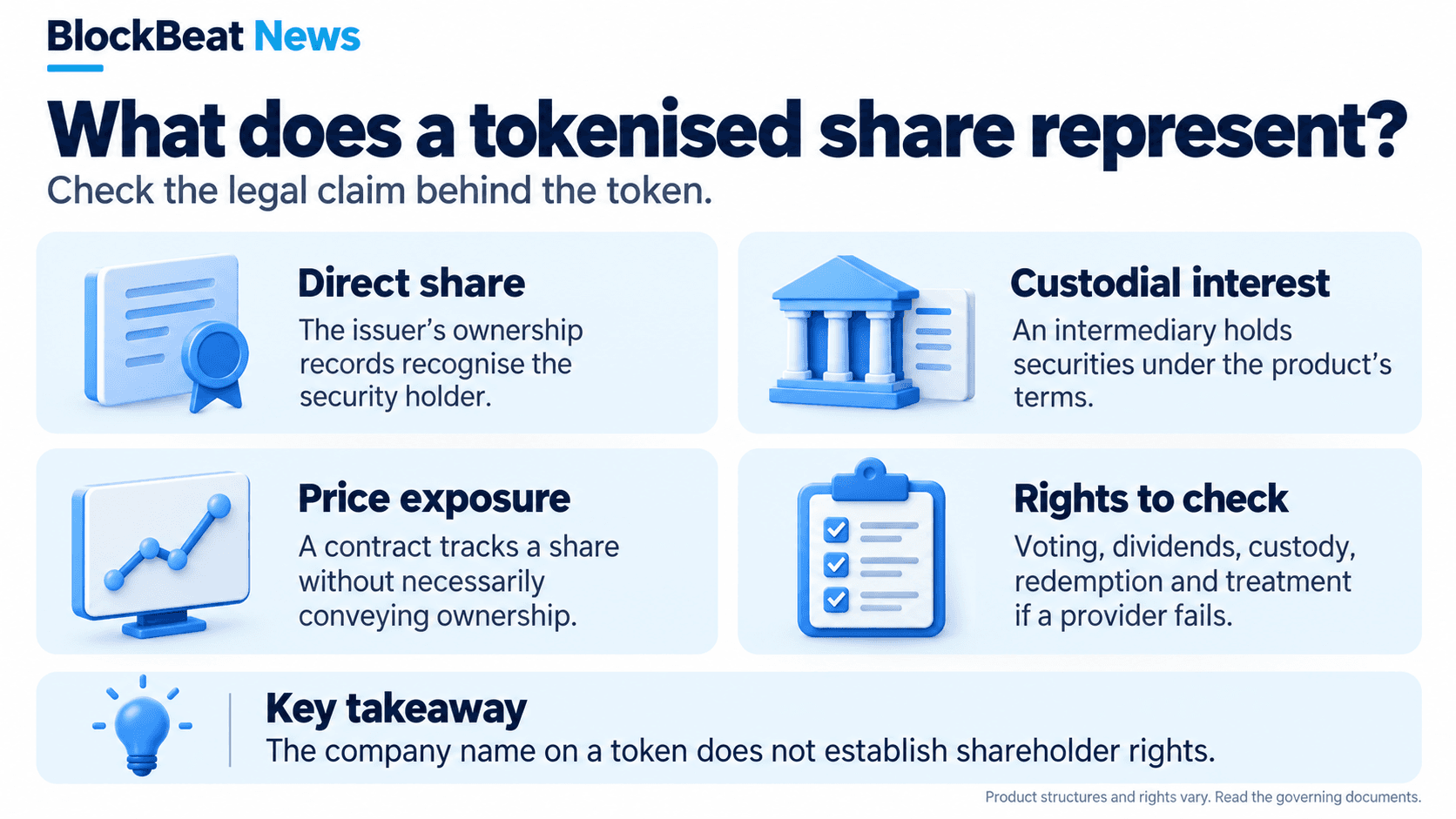
Read the infographic as text
What does a tokenised share represent?
Check the legal claim behind the token.
- Direct share
- The issuer’s ownership records recognise the security holder.
- Custodial interest
- An intermediary holds securities under the product’s terms.
- Price exposure
- A contract tracks a share without necessarily conveying ownership.
- Rights to check
- Voting, dividends, custody, redemption and treatment if a provider fails.
Key takeaway: The company name on a token does not establish shareholder rights.
Product structures and rights vary. Read the governing documents.
A token carrying a company’s name does not, by itself, make its holder a shareholder in that company. It may record the share directly, represent an interest held through an intermediary or provide a contractual return linked to the share price.
Those arrangements can look similar on a trading screen. Their differences become important when a dividend is paid, a vote is held, a transfer is restricted or the platform holding the underlying assets fails.
Start with the legal instrument
Tokenisation describes how an asset or related claim is represented and transferred using a digital ledger. It does not establish which claim exists. To identify that claim, read the issuer’s documents and the terms governing the token, custody and redemption.
In a January 2026 staff statement on tokenised securities, US SEC divisions distinguish issuer-sponsored arrangements from third-party models. Their discussion includes custodial interests and synthetic exposure, where a token’s rights may differ from the referenced security. The document is staff guidance, not a new Commission rule or a determination about every product; other jurisdictions require their own analysis.
That distinction is the starting point for a product review. A blockchain record can be technically clear while the investor’s legal relationship still requires several documents to understand.
Three arrangements to distinguish
An issuer-sponsored token may represent a company security within the issuer’s ownership-record arrangements. The documents need to explain how transfers on the ledger affect the official register and who is recognised as entitled to the security.
In a custodial model, an intermediary holds securities and issues tokens representing an interest or entitlement through its structure. The holder’s practical access can depend on the custodian, the terms of the claim and the legal treatment of client assets. Evidence that shares exist does not, on its own, explain every token holder’s rights over them.
A synthetic product can deliver economic exposure through a contract without giving the holder ownership of the referenced share. Its payments may track a price or an adjusted return. A familiar ticker and similar price movement are insufficient evidence of voting rights, direct ownership or an entitlement to receive the underlying security.
These are useful categories, not an exhaustive legal classification. A product may combine several intermediaries or impose conditions that materially change its operation.
The answer can therefore be ownership of the share itself, an indirect ownership interest through an intermediary or a contractual claim providing price exposure. The legally enforceable arrangement determines which applies.
For a concrete example, Robinhood describes its Stock Tokens issued by Robinhood Assets (Jersey) Limited as tokenised debt securities. They provide economic exposure to shares and ETFs without granting legal or beneficial rights in the underlying securities or rights against their issuers. That product's terms illustrate why a token's reference to a listed company does not establish shareholder rights in that company; other tokenised securities can carry ownership rights.
Test the claim with ordinary shareholder events
Consider hypothetical exposure equivalent to one £100 share in a company paying a £2-per-share dividend. A direct share may carry a dividend entitlement under its governing arrangements. An intermediary product might pass through a corresponding amount after deductions. A synthetic contract could adjust its payoff under a separate formula. The screen’s company name cannot tell you which outcome applies.
The same exercise works for a shareholder vote or a stock split. Who receives the notice? Can the holder instruct a vote? Does the number of tokens change automatically, or does the provider adjust an internal calculation? These are questions about the contract and operating process, rather than the speed of the network.
Tax treatment may differ too. A payment designed to resemble a dividend need not have the same legal or tax character as the dividend itself. The relevant jurisdiction and product structure must be identified before making that comparison.
Redemption and failure reveal the dependencies
Find out whether an ordinary holder can redeem, for what asset, through whom and at what minimum size. There may be identity checks, charges, processing windows or geographic limits. A market price close to the referenced share does not prove redemption is available to every buyer.
Then follow a failure scenario. If the trading venue stops operating, can tokens move elsewhere? If the custodian fails, which entity holds the securities, how are they segregated and what claim does the holder have? A transferable token cannot solve a missing legal entitlement.
The interface is another dependency. Our guide to centralised services behind decentralised applications explains why a functioning network does not guarantee that a particular website remains available.
Our Commentary on institutional blockchain infrastructure considers why records, institutions and settlement arrangements must work together.
Longer trading hours do not remove the underlying market
A token venue may permit trading while the referenced stock exchange is closed. That does not make the underlying share equally easy to price or hedge during those hours. Spreads, inventory and available buyers may change; a quoted price can diverge from the next opening price of the share.
Before evaluating the convenience of a tokenised product, establish the issuer, the exact claim, the custodian, the corporate-action terms and the exit route. The decisive evidence is a documented chain of rights from the token holder to the promised asset or payment.
Related reading
Intelligence ·
Banks bring stablecoins and DeFi settlement into financial services
Stablecoins, tokenised assets, institutional lending and blockchain settlement are beginning to converge with traditional finance, suggesting DeFi's next phase could be far less visible than its first.
Intelligence ·
DTCC launches 34 securities while 33 companies challenge OKX-ICE tokenisation
DTCC has activated a tokenised securities service for 20 clients, while 33 companies have objected to an OKX-ICE proposal covering their shares. The competing developments show that control over ownership records and investor rights is becoming decisive in blockchain deployment.
Commentary ·
Bank of England signals support for tokenised financial markets
The Bank of England’s latest remarks on tokenisation suggest the UK is moving from blockchain experimentation toward redesigning parts of financial market infrastructure.
Guides ·
SWIFT versus blockchain payments: what is actually being compared?
Messaging, settlement assets and the recipient's access to money are different layers. Compare a complete payment route before judging cost or speed.