
Polymarket Is Turning Speculation Into a Media Product
Prediction markets such as Polymarket are evolving beyond gambling narratives and becoming real-time information infrastructure competing with media, polling, and financial analysis.




Original analysis from the BlockBeat News editorial team and invited guest contributors.
Prediction markets such as Polymarket are evolving beyond gambling narratives and becoming real-time information infrastructure competing with media, polling, and financial analysis.

Stablecoins are evolving from trading instruments into core liquidity infrastructure underpinning decentralised finance, payments, and tokenised markets.

The Bank of England’s latest remarks on tokenisation suggest the UK is moving from blockchain experimentation toward redesigning parts of financial market infrastructure.

Samsung’s labour dispute reveals how the AI boom is changing expectations around wages, productivity, and ownership inside strategically critical industries.

Claims that XRP is cheaper than SWIFT in Japan reflect a deeper shift in cross-border payments, where settlement speed, liquidity design, and infrastructure control are redefining cost and competitive advantage.

As AI systems increasingly train on synthetic outputs, signal quality degrades and the economic value of authentic human-generated data rises, reshaping media, marketing, and platform economics.

As generative systems scale, ownership will no longer be inferred from content itself but enforced through cryptographic provenance layers, redefining monetisation, trust, and distribution across media, marketing, and publishing.

Governments are investing in domestic AI infrastructure to reduce dependency on foreign cloud providers, signalling a shift towards negotiated control of compute, energy, and data rather than full technological independence.

Meta, Apple and OpenAI are not competing on devices but across different layers of the interface stack, where distribution, environment and decision control determine how commercial value is captured.
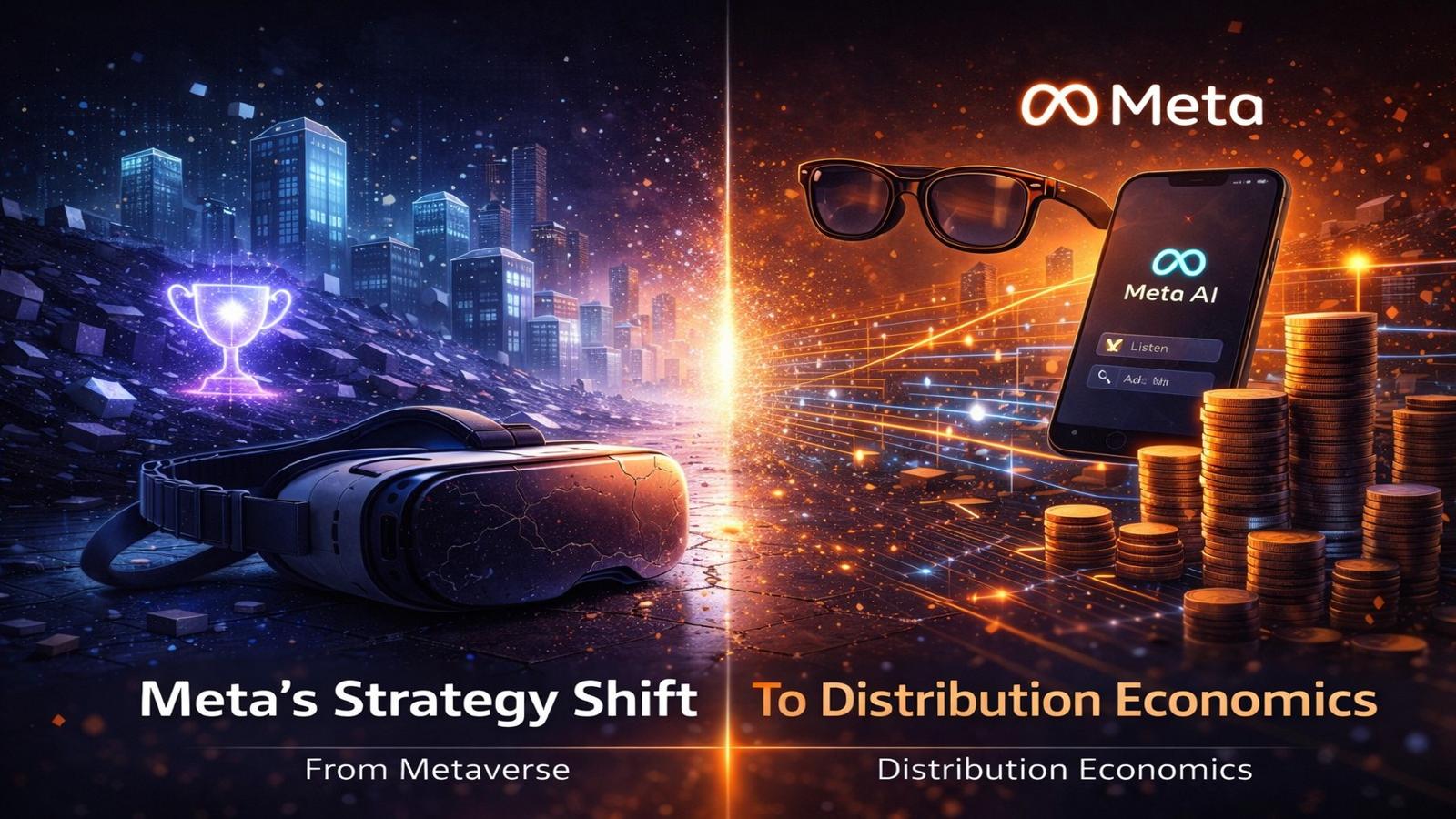
Meta’s retreat from VR-first metaverse ambition reflects a shift from speculative platform building to cost-controlled, AI-aligned distribution across mobile and wearables.

Hospitality access systems still rely on duplicable credentials and operational workarounds. NFT-based access introduces a model where room entry becomes a programmable entitlement, with implications for cost, liability and control.

A bipartisan US housing bill includes provisions that would restrict the Federal Reserve from issuing a retail central bank digital currency, highlighting growing political resistance to programmable state money.

A new crypto initiative called Quest Colossus is attempting to bypass Visa and Mastercard with KYC-less payment cards, highlighting the growing tension between decentralised finance and the compliance infrastructure of global card networks.

Strategy's Bitcoin accumulation strategy is less about corporate conviction and more about transforming capital markets into a financing engine for Bitcoin acquisition.

Rising Middle East tensions are increasing volatility across global markets, forcing investors to reassess how Bitcoin and major crypto assets behave during geopolitical shocks.

Artificial intelligence is rapidly reshaping recruitment, creating a feedback loop where AI-generated applications are increasingly screened by automated hiring systems.

Modern conflict increasingly targets energy supply routes, financial settlement networks and digital infrastructure that transmit shocks through the global economy.

Zero-knowledge identity systems and portable data credentials are restructuring digital power, shifting economic leverage from platforms towards individuals and redefining advertising economics.

As AI agents gain the ability to hold wallets, negotiate contracts, and settle payments on-chain, enterprise procurement and SaaS pricing models face structural disruption.

Stablecoins are rebuilding cross-border payment rails outside traditional correspondent banking networks, compressing settlement time, FX spreads, and float income in ways incumbent banks are structurally slow to confront.

As machines gain the ability to settle payments autonomously using stablecoins and programmable payments, IoT infrastructure is shifting from data transmission to value exchange, repricing energy, bandwidth, and cloud control.

Google, OpenAI, Meta and Microsoft are repositioning advertising around AI-mediated influence rather than placement. As intent moves upstream into answer engines and copilots, both publishers and advertisers must rethink revenue and engagement models.

AI is reshaping tasks across industries, but economic reality, liability, embodiment, and human trust limit how far and how fast full job replacement can occur.

Web3 promised financial autonomy, decentralised infrastructure, and user-controlled data. As stablecoins, exchanges, and dApps integrate with banks and Big Tech, the ecosystem is converging with the institutions it set out to rebalance.

Decentralised applications promised to reduce reliance on hyperscale cloud providers, yet most still depend on centralised infrastructure. The real question is which layers can meaningfully decentralise and what that means for CIOs and policymakers.

Web3 marketing succeeds when it understands who the audience is, why they matter economically, and how credibility and incentives shape behaviour before messaging does.

Central bank digital currencies promised a state-led future of money, but political risk, institutional inertia, and public resistance stalled deployment while stablecoins scaled quietly in their place.

A four to five-year review of exchange volumes and failures shows that survival now depends on banking access, compliance endurance, and regulatory resilience rather than trading features.

Governments and large institutions are no longer piloting blockchain in the abstract. They are deploying specific networks for payments, identity, records, and public infrastructure, quietly narrowing adoption to chains that meet real-world operational and governance requirements.

As consumer appetite for immersive worlds cooled, augmented reality advanced pragmatically, intersecting with education, work, and regulation as governments reassess screen time, advertising, and digital wellbeing.

As AI turns electricity into predictable revenue, energy pricing is reshaping how processing power is used and quietly raising the cost of decentralised participation worldwide.

The collapse of metaverse hype exposed flawed assumptions about behaviour, timing, and incentives, while leaving behind quieter infrastructure that continues to mature without spectacle.

New regulatory frameworks are forcing Web3 to mature structurally, exposing tensions between decentralisation, compliance, and real-world adoption rather than ending the experiment.

As prices collapse and marketplaces close, NFTs are being repurposed as functional infrastructure across identity, access, and enterprise systems.

The rise of harvest-now, decrypt-later strategies is forcing blockchains, wallets, and institutions to treat cryptographic agility as a long-term security requirement.

The recent Bitcoin sell-off was driven by leverage, liquidity mechanics, and forced positioning rather than a shift in long-term conviction.