



Hotel Key Systems Are Exposing Liability and NFTs Point to a Different Control Model
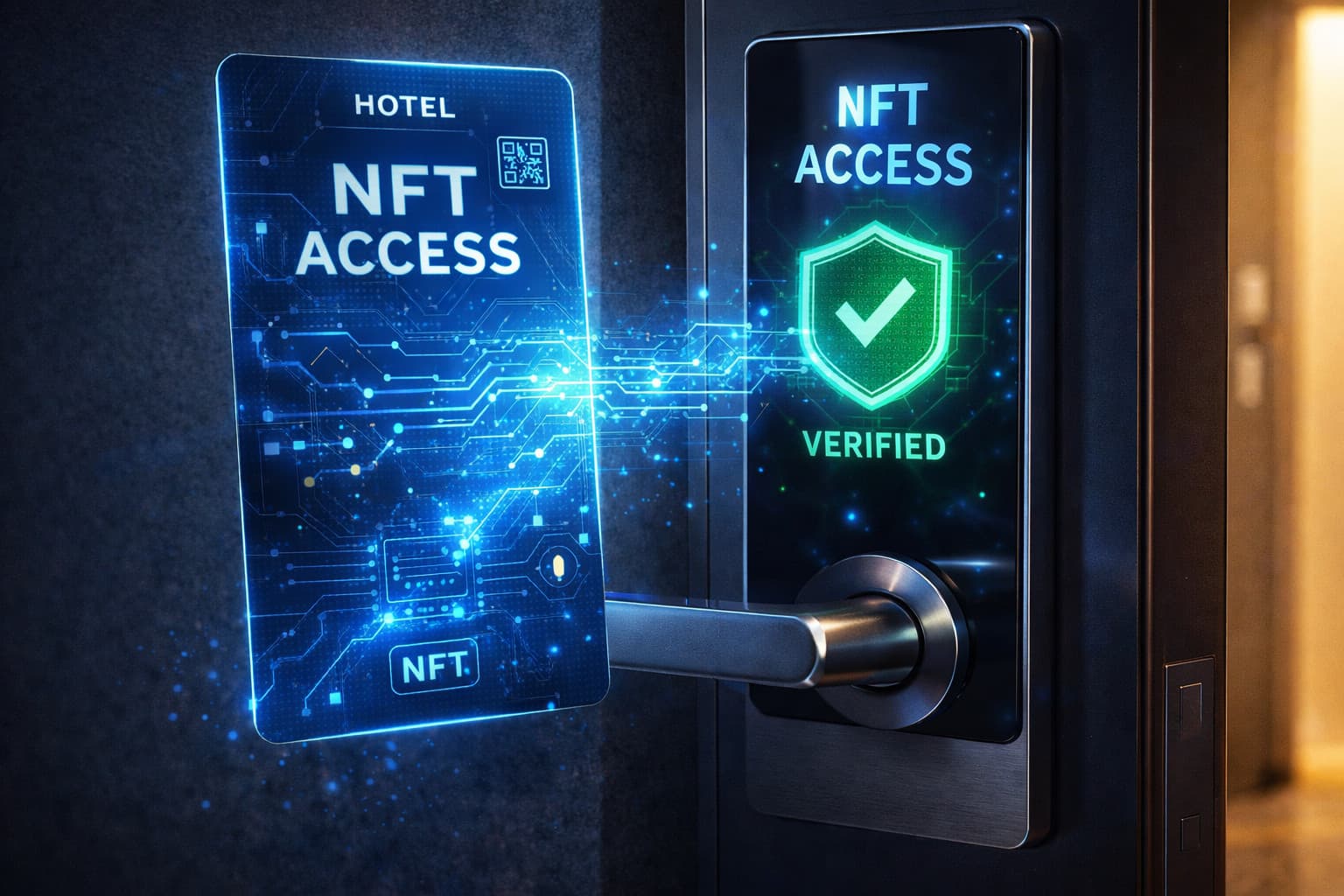
Hospitality access systems still depend on duplicable credentials and operational fallbacks, creating measurable liability. NFT-based keys introduce a model where access is unique, time-bound and programmable, shifting control away from process and into infrastructure.**
The real problem is not the key, it is the control model behind it
Hotels and short-let platforms have already transitioned toward digital access, though the underlying architecture has not changed in any meaningful way. Mobile keys, such as those used by Hilton, demonstrate that guests are comfortable using their phones as entry devices, while Airbnb’s integration with smart locks shows how access can be tied to booking windows rather than physical handover. (Hilton Digital Key)
What has not changed is how access is controlled.
Credentials can still be duplicated, reissued, overridden or extended when operational pressure demands it, and fallback processes are routinely introduced when systems fail or guests encounter friction. Airbnb’s own documentation makes clear that alternative access methods may be shared when standard processes break down. (Airbnb Smart Lock Guidance)
At the infrastructure level, the exposure is more explicit. The dormakaba Saflok vulnerability showed that, under certain conditions, forged keycards could unlock hotel rooms at scale, exposing a systemic weakness in how access credentials are generated and trusted. (NIST CVE-2024-29916)
This is not a user error issue. It is a structural flaw in how access is defined.
Why this becomes a commercial and legal liability
Access control in hospitality is often treated as a background operational function, although it carries direct commercial consequences. When credentials can be duplicated or overridden, the system loses clarity over who has access, when that access is valid, and whether it has been properly revoked.
That ambiguity creates risk across several dimensions, including guest safety, dispute resolution, insurance exposure and brand trust. It also introduces operational cost through lock resets, manual interventions and support processes that exist solely to manage exceptions.
The core issue is that access today is still based on reproducible permission rather than unique entitlement.
NFTs shift access from permission to entitlement
NFTs are relevant because they formalise access as a singular, verifiable object rather than a copyable credential.
A room key is inherently constrained by context, defined by a specific guest, location and time window. These constraints map directly onto what NFTs can encode, particularly when combined with permission controls and identity binding.
Hospitality platforms such as Mews have already identified bookings and guest access as practical applications of NFT infrastructure, especially where exclusivity and verification are required. (Mews NFT in Hospitality)
Adjacent markets provide further validation. NFT-based ticketing models have demonstrated that access can be tied to a unique token, enabling verification at the point of entry while reducing duplication and fraud. (MoonPay NFT Ticketing)
The shift is not cosmetic. It changes the definition of access itself.
How an NFT-based key would operate in practice
In a tokenised model, the booking process would issue a unique NFT representing the right to access a specific room for a defined period, with permissions encoded directly into the credential. Sensitive guest data would remain off-chain, while the token acts as the entitlement layer that can be verified independently.
At the point of entry, the lock system validates ownership and timing conditions before granting access, removing the need for duplicated credentials or manual overrides. When the stay ends, the token is automatically revoked or expired through predefined logic, eliminating the risk of lingering access.
Every stage of this lifecycle, from issuance to revocation, can be recorded, creating a clearer audit trail than current systems typically provide.
Why this model is structurally stronger
The advantage of this approach is not incremental improvement, though a shift in how control is enforced.
A unique token cannot be duplicated in the same way as a card or code, which reduces ambiguity around access. Time-bound permissions become enforceable at the infrastructure level rather than dependent on staff processes, and revocation becomes deterministic rather than operational.
This also creates a more flexible access layer, where a single credential can extend beyond the room to include amenities, events or premium services, effectively turning the key into a programmable component of the guest experience.
The revenue implication is understated
Access control is typically viewed as a cost centre, although the ability to attach permissions and entitlements to a programmable credential introduces new commercial possibilities.
Hotels and operators could bundle premium access into the same token, extend guest relationships beyond the stay, or introduce controlled transfer models for certain types of access. In this context, the key becomes part of the revenue architecture rather than a purely functional tool.
Where the argument needs discipline
It is important not to overstate the case.
NFTs do not address weaknesses in physical lock hardware, nor do they eliminate risks associated with social engineering or identity verification. The Saflok vulnerability illustrates that hardware-level security remains a critical dependency regardless of how credentials are issued. (NIST CVE-2024-29916)
The value of NFTs sits specifically in strengthening the credential layer, not replacing the broader security system.
Strategic conclusion
The hospitality sector has already accepted digital access, and the remaining question is how that access is defined and controlled.
The current model relies on credentials that can be reproduced, overridden and managed operationally. A tokenised model replaces that with unique, programmable entitlements that can be verified and revoked with greater certainty.
Adoption remains early, although the commercial logic is clear.
Access control is shifting from duplicated permission to programmable entitlement, and that transition carries direct implications for liability, cost structure and revenue design across hospitality.
---