



The Internet of Things Is Quietly Becoming a Financial Network
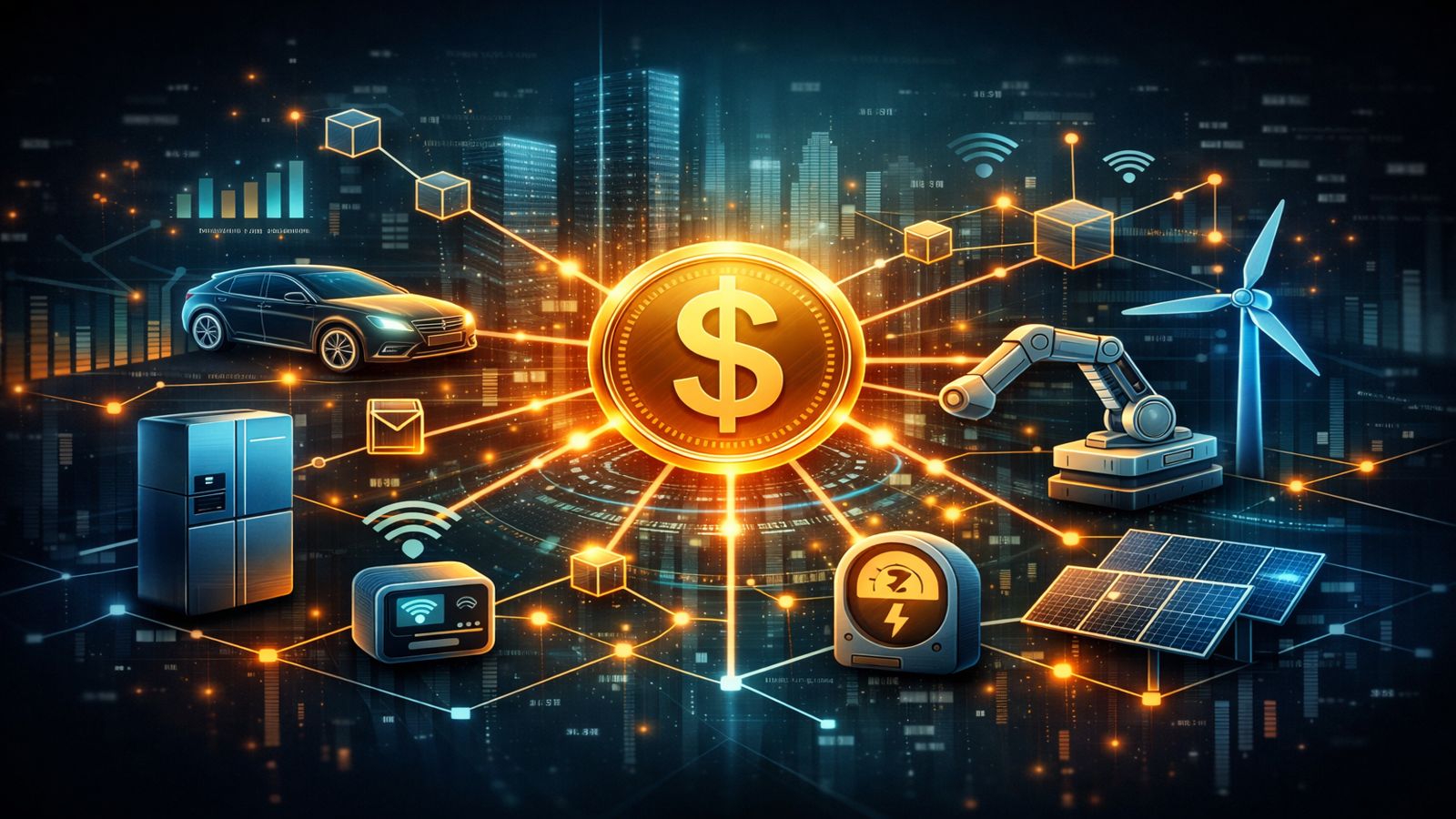
IoT is evolving from a data collection layer into a machine-to-machine settlement network, where devices transact value directly using stablecoins and programmable payments.
Your fridge is not strategically interesting. A million machines settling payments autonomously is.
The commercial shift underway is not about sensors, dashboards, or analytics. It is about machines acquiring the ability to transfer value without human mediation. When IoT devices combine with stablecoins and programmable payment rails, infrastructure economics change. Pricing becomes granular. Settlement becomes continuous. Control shifts upstream.
The result is not incremental efficiency. It is financialisation of the physical layer.
Data transmission is giving way to value exchange
For the past decade, IoT has been framed as a data story. Sensors collect information. That information flows to cloud platforms. Analytics extract insight. Humans make decisions.
This model centralised both intelligence and monetisation. Devices were endpoints. Cloud platforms were control centres. Revenue accrued to those who owned aggregation and processing.
Machine-to-machine payments alter that structure.
When devices can settle small amounts of value directly, they no longe rely exclusively on subscription billing or centralised reconciliation. An electric vehicle can pay a charging station per kilowatt hour in realtime. A sensor can pay for bandwidth per packet transmitted. A drone can purchase airspace access dynamically.
The transaction layer becomes embedded in the device itself.
Commercially, this disintermediates parts of the billing stack. It also introduces a new one. The payment rail.
Stablecoins enable micro-settlement at machine scale
Traditional payment systems are not built for machines. Card networks, direct debits, and bank transfers assume human identity, discrete invoices, and batch settlement. Machine networks operate continuously.
Stablecoins, particularly dollar-denominated digital cash equivalents, allow programmable settlement at low cost and high frequency. Transactions can be executed in seconds, reconciled automatically, and audited transparently.
This matters at scale. A single IoT device paying fractions of a penny per interaction is irrelevant. A fleet of one million devices settling every few seconds is a liquidity system.
The economic implication is that infrastructure services can be repriced around usage rather than access. Energy, storage, compute, and connectivity shift from subscription models towards streaming revenue.
For operators, that increases revenue precision. For buyers, it compresses idle cost. For intermediaries, it threatens margin.
Tokenised energy grids are an early indicator
Energy markets offer a preview of this transition.
Smart meters already measure consumption at granular intervals. Distributed generation from solar panels and batteries introduces two-way flow. What has been missing is frictionless settlement.
Tokenised energy systems allow households, vehicles, and grid nodes to transact directly based on supply and demand conditions. Surplus energy can be sold in near real time. Consumption can be priced dynamically. Microgrids can self-balance economically as well as electrically.
The commercial consequence is significant. Utilities shift from volumetric billing cycles to continuous financial interaction. Platform operators that control the token layer gain visibility into flows of both energy and capital.
Pricing power moves towards whoever controls the settlement protocol.
Micropayments restructure infrastructure margins
Micropayments are often dismissed as a theoretical benefit of blockchain systems. In IoT, they are structural.
Bandwidth, storage, and compute are consumed in tiny increments by millions of devices. Today, those costs are bundled into contracts, often through large cloud providers. The pricing model favours scale buyers and penalises fragmentation.
If devices can negotiate and settle independently, they can source services dynamically. A device might choose the cheapest available bandwidth at a given moment. It might switch storage providers automatically based on latency and cost.
This introduces market behaviour into infrastructure procurement.
For cloud providers, this is a margin risk. Aggregation has historically delivered pricing power. Granular machine procurement reduces lock-in and increases price transparency.
The counter-move is predictable. Embed financial services directly into the cloud stack.
Big Tech's lock-in risk intensifies
The largest cloud providers already dominate IoT management layers. Device identity, authentication, data routing, and analytics frequently run through their infrastructure.
If machine payments become native, control over identity and wallet infrastructure becomes strategic.
Cloud providers are well positioned to integrate custody, compliance, and programmable payment rails directly into IoT offerings. Doing so would preserve their role as gatekeepers. Devices would transact, but through managed environments.
The alternative is open settlement networks where devices hold their own wallets and interact across platforms.
This is the fault line.
If machine payments are mediated by hyperscalers, IoT financialisation deepens platform dependency. If settlement layers remain open, pricing becomes more competitive and portable.
For enterprises deploying IoT fleets, this decision affects long-term cost structures and bargaining power.
Machine identity becomes financial identity
Once devices transact value, identity becomes more than a security issue. It becomes a financial attribute.
Each device requires a verifiable identity capable of holding and transferring digital assets. This introduces compliance, audit, and governance considerations traditionally reserved for human actors.
Enterprises must determine who controls device wallets, how keys are rotated, and how liability is allocated in case of malfunction or fraud.
This increases the importance of secure hardware modules and cryptographic agility. Devices become economic agents within corporate balance sheets.
The accounting treatment of autonomous micro-transactions will not remain a technical detail. It will shape reporting, tax treatment, and regulatory classification.
Infrastructure is being repriced in real time
The core thesis is not that IoT devices will hold speculative tokens. It is that infrastructure services will be repriced through programmable settlement.
When payment becomes embedded and continuous, billing cycles compress. Credit risk reduces. Revenue visibility improves. Pricing can adjust dynamically based on demand conditions.
For service providers, this supports yield optimisation. For customers, it increases exposure to volatility.
This mirrors financial markets. Spot pricing replaces fixed tariffs. Liquidity becomes an asset. Hedging tools become necessary.
IoT combined with stablecoins effectively turns physical infrastructure into a tradable, continuously priced resource layer.
Who gains leverage
Settlement layer providers gain structural influence. Wallet infrastructure, stablecoin issuers, and protocol operators sit at the junction of physical and financial flows.
Cloud providers either consolidate control by embedding these capabilities or lose margin to more open ecosystems.
Energy and telecom operators gain precision but face price competition as transparency increases.
Enterprises deploying IoT fleets gain optionality if they avoid lock-in. They lose negotiating leverage if financial rails are bundled into proprietary stacks.
Banks face disintermediation risk in micro-settlement environments unless they integrate digital currency infrastructure directly.
What this changes for strategy
Executives treating IoT as a data optimisation layer are underestimating the shift.
The strategic question is not how many devices are connected. It is who controls the payment rail those devices use.
If IoT becomes a financial network, revenue models across energy, logistics, manufacturing, and urban infrastructure will evolve from contracts to streams. Pricing power will accrue to those who manage liquidity and identity at scale.
This is not a consumer story. It is an infrastructure story.
A connected thermostat transmitting data is incremental. A million autonomous devices settling payments continuously is systemic.
The internet moved information. The next phase moves value between machines.
That transition will not be announced. It will be priced in.