



How crypto liquidations turn a price fall into a sell-off
BlockBeat Guides
Borrowed positions can create selling that participants no longer choose. A worked example shows how collateral limits, liquidators and market depth connect.
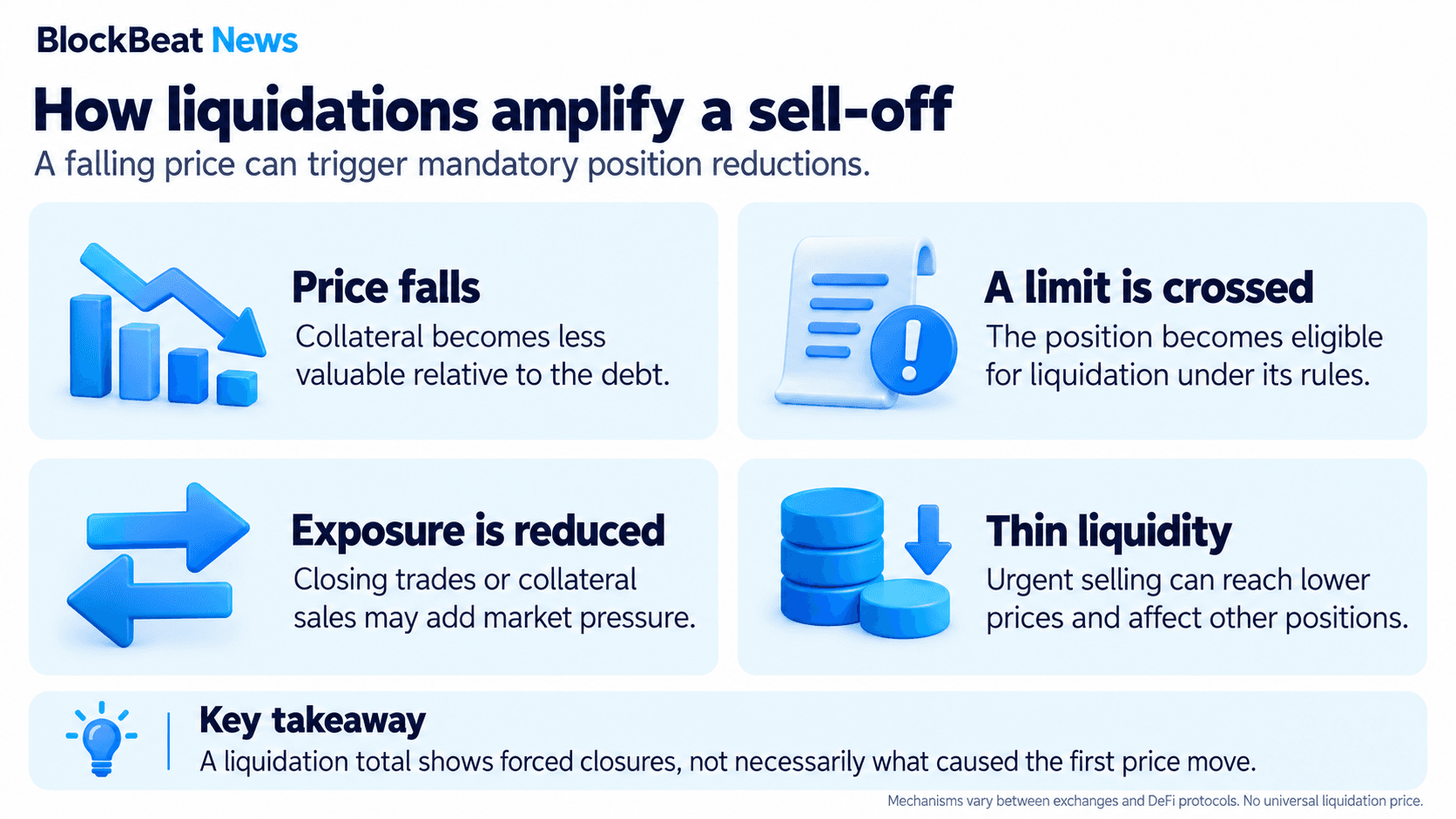
Read the infographic as text
How liquidations amplify a sell-off
A falling price can trigger mandatory position reductions.
- Price falls
- Collateral becomes less valuable relative to the debt.
- A limit is crossed
- The position becomes eligible for liquidation under its rules.
- Exposure is reduced
- Closing trades or collateral sales may add market pressure.
- Thin liquidity
- Urgent selling can reach lower prices and affect other positions.
Key takeaway: A liquidation total shows forced closures, not necessarily what caused the first price move.
Mechanisms vary between exchanges and DeFi protocols. No universal liquidation price.
A falling price can trigger a second source of selling: positions that must be reduced because their collateral no longer supports their debt. When many accounts reach that point together, the response can deepen the original decline.
The process differs between a leveraged exchange trade and a loan secured through a DeFi protocol. Both involve a financial limit, but they do not necessarily use the same prices, thresholds or method of closing a position.
Leverage makes the capital buffer smaller
Imagine a hypothetical trader using £2,000 of their own money to support £10,000 of exposure. A 5% adverse price movement produces a £500 loss before fees and financing costs. That is one quarter of the trader’s initial capital, despite the asset moving only 5%.
The platform may act before that capital is exhausted. Maintenance-margin requirements specify how much support must remain, while the platform’s contract determines its liquidation process. Additional fees, collateral movements and the price used to assess the position can all change the outcome.
The CFTC explains how leverage magnifies losses in virtual-currency trading. It is a mechanism, rather than a claim that every platform closes the same trade at the same level.
A collateralised loan provides another route
Consider a separate, simplified DeFi example: collateral worth £10,000, debt worth £6,000 and a hypothetical liquidation threshold of 80%. The supported amount at that threshold is £8,000, leaving a health-factor ratio of £8,000 divided by £6,000, or about 1.33.
If the collateral falls to £7,000 while the debt stays at £6,000, that ratio becomes £5,600 divided by £6,000, or about 0.93. The position has crossed a threshold of 1. These are illustrative inputs, not current terms for a particular market.
Aave’s explanation of health factors and liquidation describes this relationship between collateral, debt and liquidation thresholds. The relevant parameters and permitted liquidation amounts depend on the market and protocol version; a reader should check the actual position rather than import the example as a rule.
In this type of mechanism, an external liquidator can repay eligible debt and receive collateral under the protocol’s terms. That differs from assuming a central operator simply sells the borrower’s entire account at the last quoted exchange price.
How the pressure reaches the market
A liquidator that receives collateral may sell it to recover the asset used for repayment, or hedge the exposure elsewhere. An exchange closing a long derivatives position may execute offsetting trades or use its own risk-management process. The exact route matters, but either can add urgent orders during an already stressed period.
Now imagine that ordinary bids have thinned because traders are cancelling orders. The same quantity of selling reaches progressively lower prices. Those prices can push more positions towards their own limits, creating a feedback loop.
Forced closures can also amplify a rally. Traders with short positions may need to buy back exposure as the price rises. Liquidation is therefore a risk-control process whose market effect depends on the position being closed, rather than a synonym for selling in every circumstance.
A liquidation total does not identify the original cause
A headline number can show that forced closures accompanied a movement. It cannot establish whether the first trigger was a large spot sale, a change in funding conditions, a security incident or another event.
Compare the time window, covered exchanges, contract types and data methodology before combining figures. Open interest measures outstanding derivatives positions, while volume measures trading over a period. Neither is interchangeable with a liquidation total. On-chain protocols may also use oracle prices that differ from a particular exchange’s latest trade.
The collateral behind a loan brings its own dependencies. Our guide to what a tokenised share actually represents explains why an asset’s label does not establish its legal rights; our guide to DeFi yield follows how lending income relates to the risks suppliers accept.
When examining the next sharp decline, separate the initial price change from the rules that converted it into mandatory action. The important evidence is the sequence: which limits were crossed, how positions were reduced and whether available buyers could absorb the resulting trades.
Related reading
Intelligence ·
Tokenised securities expand DeFi lending and collateral markets
Tokenised securities and funds are moving beyond issuance into lending, collateral and settlement. The shift positions DeFi as financial infrastructure, while making liquidity, redemption and risk assessment increasingly important.
Intelligence ·
DeFi lending and settlement connect tokenised assets to capital markets
Tokenised equities, funds and private-market instruments are increasingly connecting to DeFi lending, collateral and settlement infrastructure. The shift expands DeFi’s addressable market, but also places greater weight on stablecoin concentration, issuer controls and institutional risk standards.
Guides ·
What do you actually own when you buy a tokenised share?
A token can represent a company share, a claim through an intermediary or a product tracking the price. The legal rights matter more than the ticker or blockchain.
Guides ·
How tokenised assets become collateral in DeFi
A lending protocol needs more than an asset token. Legal rights, transfer permissions, valuation and a workable recovery route determine whether it can support a loan.