



Why your crypto trade costs more than the advertised fee
Trading Essentials Series 3 of 6
Work through spreads, slippage, maker and taker fees, and the difference between a price move and the profit you actually keep.
Only put money into crypto that you can afford to lose in full. This guide is for education and is not personal financial advice. Do your own research into the asset, platform, fees and risks before making a decision.
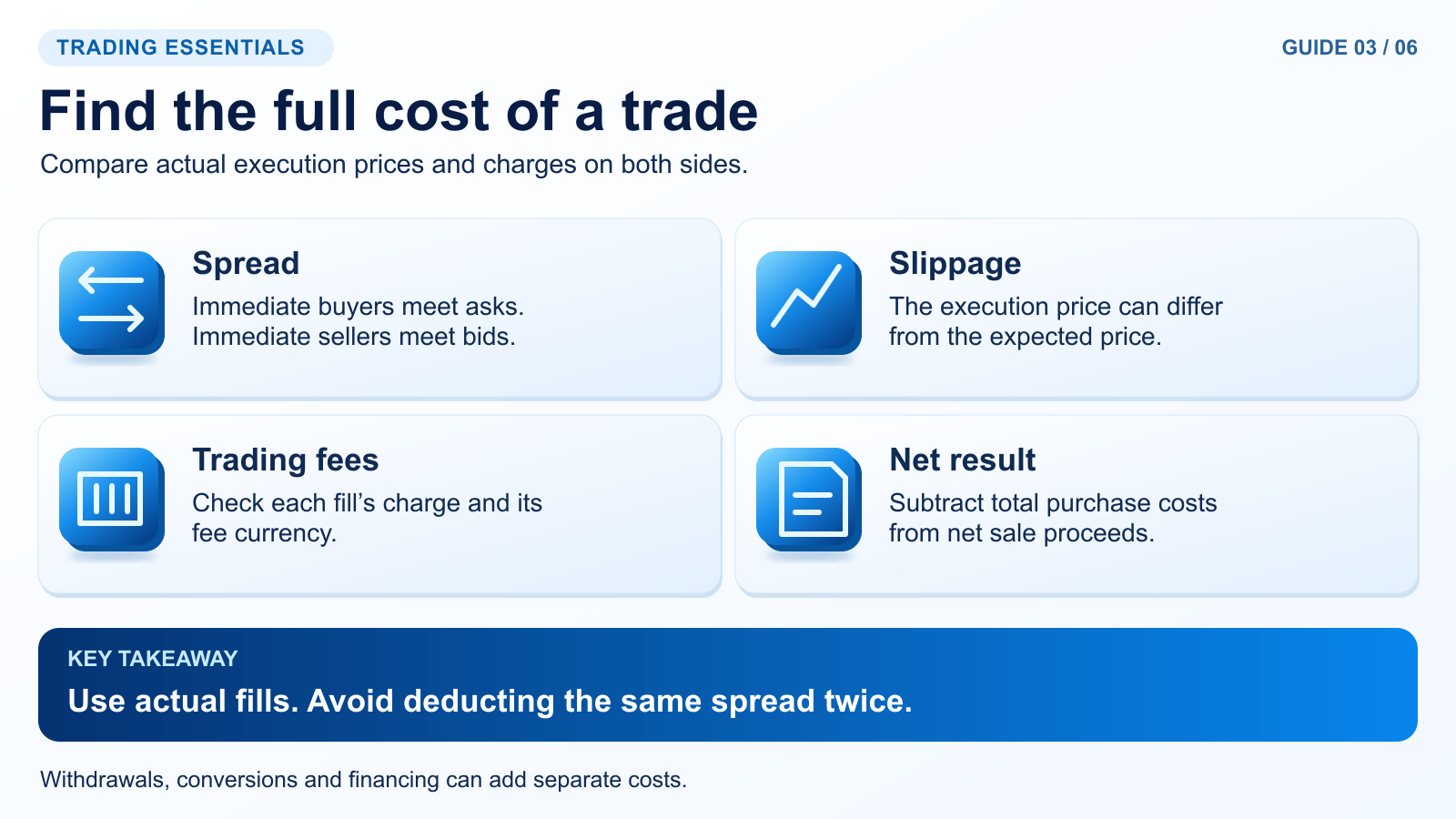
Read the infographic as text
Find the full cost of a trade
Compare actual execution prices and charges on both sides.
- Spread
- Immediate buyers meet asks. Immediate sellers meet bids.
- Slippage
- The execution price can differ from the expected price.
- Trading fees
- Check each fill’s charge and its fee currency.
- Net result
- Subtract total purchase costs from net sale proceeds.
Key takeaway: Use actual fills. Avoid deducting the same spread twice.
Withdrawals, conversions and financing can add separate costs.
View the worked example and calculation
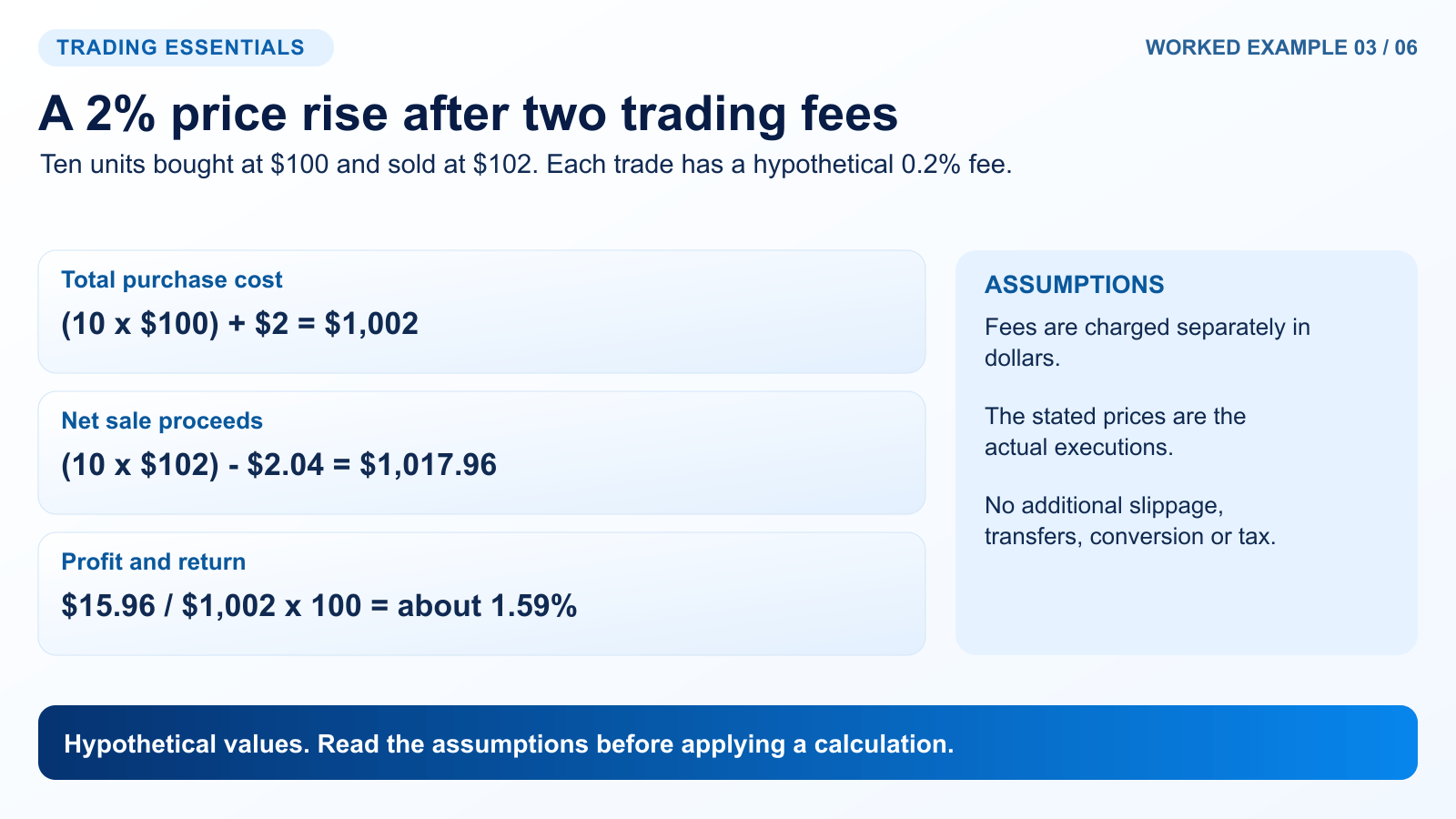
A 2% price rise after two trading fees
Ten units bought at $100 and sold at $102. Each trade has a hypothetical 0.2% fee.
- Total purchase cost
- (10 x $100) + $2 = $1,002
- Net sale proceeds
- (10 x $102) - $2.04 = $1,017.96
- Profit and return
- $15.96 / $1,002 x 100 = about 1.59%
Fees are charged separately in dollars.
The stated prices are the actual executions.
No additional slippage, transfers, conversion or tax.
A token’s price rises after you buy it, yet selling would leave you with less cash than you started with. The difference can come from the prices available to you on each side of the trade and the charges applied along the way.
Start with the bid and the ask
In an order book, the best bid is the highest price currently offered by a buyer. The best ask is the lowest price currently requested by a seller. Imagine a best bid of $99 and a best ask of $101. Someone buying immediately meets the $101 ask. Someone selling immediately meets the $99 bid. The $2 difference is the bid-ask spread. A last-traded price of $100 does not mean you can buy or sell any quantity at $100.
If you buy one unit at $101 and immediately sell it at $99, the difference is a $2 loss before explicit fees, assuming those prices remain available. This is a worked illustration of crossing a spread. It does not mean the exchange collects a separately itemised $2 commission. Resting orders may come from other customers or professional market makers. An instant purchase service may instead quote a price that includes its own spread, as described in Coinbase’s execution policy. Coinbase order execution policy
When comparing providers, keep the asset, network, size and time as consistent as possible. Two displayed prices may refer to different pairs or methods of valuing the balance. Compare the money paid with the units received and, for the exit, the money you would receive for selling those same units.
A larger order can meet several prices
The best ask says little about how much is for sale there. Suppose an order book offers two units at $100 and three more at $102. Buying five would cost (2 × 100) + (3 × 10²) = $506 before commission, if those orders remain available. The average price is 506 ÷ 5 = $101.20. Against a $100 reference, the difference is $1.20 per unit, or 1.2%. The example isolates order size and depth. In a live market, other orders and prices can change during execution.
Slippage describes the difference between an expected price and the actual execution. It can be favourable or unfavourable. Thin liquidity and fast changes can make the result less predictable. An order that uses up the best offers has a price impact as it reaches further into the book. Both effects matter when estimating proceeds. Coinbase’s help page describes how liquidity affects slippage. Coinbase slippage guidance
A limit price can prevent execution beyond that price, but can also leave an order partly or wholly unfilled. The trade-off belongs in the decision about which order type to use. A quote’s attractiveness is of limited use if there is too little quantity available to complete the trade you intend.
Calculate both sides of the trade
Consider a different hypothetical example using a $100 purchase price and exact execution. You buy ten units for $1,000. A 0.2% trading fee charged separately adds $2, taking the total cash cost to $1,002. Later you sell ten units at $102 for $1,020. The same 0.2% fee is $2.04, leaving $1,017.96. Cash profit is $15.96 and the return on the $1,002 actually spent is approximately 1.59%.
The asset rose 2%. The return is lower because the calculation includes both fees. It assumes no slippage, no other conversion or transfer charges and no tax. Because it uses actual purchase and sale prices, any spread already reflected in those executions is already in the result. Deducting an estimated spread again would understate the profit. The expanded worked example above sets out each calculation.
Maker and taker schedules add another variable. An order that adds resting liquidity can qualify as maker activity. An order that trades against resting liquidity is taker activity. A limit order that crosses available prices can be a taker order, and one order can have different treatment for different fills. Use the fees recorded in your execution history rather than inferring the charge from the order’s name. Kraken maker and taker fee explanation
Keep trading costs separate from moving and holding costs
Moving crypto off an exchange can bring a withdrawal charge, while a self-custody transfer brings a network fee. A purchase through a card or a conversion into a different currency can add costs before the trade starts. Borrowing and perpetual funding add another set of cash flows if you use margin or derivatives. Their timing and basis depend on the product, covered in our long and short guide.
For a short-term trader, frequent entry and exit repeatedly incur the applicable execution costs. For someone holding an unleveraged asset for a longer period, custody, transfer and eventual cash-out may matter more. Write down the route you actually intend to take. A trading-fee comparison that ends with a balance on an exchange answers a different question from the cost of getting the proceeds into your bank.
Keep the order fills, fees and any separate transfers in one record. If a platform supplies an estimated profit figure, check which charges it includes and which currency it uses. Reconstructing a completed trade from those records is the most reliable way to tell whether a seemingly small fee has become a significant part of the result.
Sources
Related reading
Guides ·
What do you actually own when you buy a tokenised share?
A token can represent a company share, a claim through an intermediary or a product tracking the price. The legal rights matter more than the ticker or blockchain.
Guides ·
Crypto wallets explained: what they are, how they work and which type you need
A beginner's guide to crypto wallets, recovery phrases, private keys, hot and cold wallets, and what happens when you keep crypto on an exchange.
Guides ·
Your first crypto trade: pairs, prices and what you’re buying
Follow a hypothetical $100 crypto purchase. Learn trading pairs, fractional coins, order fills and what changes when you sell.
Guides ·
Planning a crypto trade: position size, exits and keeping records
Use a hypothetical trade to calculate position size, allow for imperfect exits and record the result after costs.