



The UK's crypto hub ambition is becoming an institutional market

The UK's emerging cryptocurrency regime is giving established financial businesses a clearer route into digital assets. Its more difficult test is whether the same framework leaves enough room for the independent developers and smaller businesses that create blockchain infrastructure.
The original crypto hub ambition included the businesses of tomorrow
When Rishi Sunak announced the UK's ambition to become a global cryptoasset technology hub in April 2022, the Treasury's programme extended beyond trading and custody. It included a financial market infrastructure sandbox, engagement with industry and a review of how taxation could encourage investment. The stated objective was to attract innovation, employment and businesses that had yet to reach scale.
That distinction is increasingly important. The UK is developing a more formal financial market for cryptocurrency, with a wider authorisation regime scheduled for October 2027 and tax reporting obligations already in force. Those measures can make the country more attractive to established institutions that need legal certainty before committing capital. They can also change the economics for businesses still trying to establish whether a product has a market.
The question is not whether regulation and innovation can coexist. It is whether the UK's framework distinguishes adequately between businesses that hold or exchange customer assets and developers who provide the software and infrastructure on which those businesses depend.
HMRC is changing the economics of operating a crypto service
Since 1 January 2026, in-scope cryptoasset service providers have been required to collect identifying information about their customers under the OECD's Crypto-Asset Reporting Framework. For UK individuals, this can include a National Insurance number or Unique Taxpayer Reference, alongside name, address and tax residence. The first annual reports, covering 2026, are due by 31 May 2027.
This is an information-reporting system, not a new tax on owning cryptocurrency. It is designed to give tax authorities greater visibility of transactions and to support international exchange of information. Tax compliance is a legitimate objective, particularly in a market where assets can move across borders without conventional banking intermediaries.
For operators, however, the requirement has a commercial cost. Customer verification, record keeping, secure handling of sensitive information, transaction classification and reporting all require investment. HMRC's rules also carry penalties for failures.
A large exchange can distribute those costs across an existing compliance operation and substantial trading volumes. A smaller business may face many of the same fixed expenses before it has enough customers to cover them. Regulation can therefore influence market structure even when the rules are formally applied without regard to company size.
There is an important limit to this argument. The reporting framework does not require every individual writing blockchain software to collect tax numbers. Its scope turns on whether a person or business provides covered services and, in some circumstances, its control or influence over the means by which transactions are carried out. Those boundaries matter more to developers than the headline requirement itself.
Blockchain infrastructure is not synonymous with financial intermediation
Much of the policy debate begins with cryptocurrency as an investment or payment asset. That captures real economic activity, but it is an incomplete description of the technology.
Bitcoin's native asset is used to reward miners for work that helps secure the network. Ethereum uses ETH to compensate validators, support staking and pay transaction fees. These assets are integral to the networks' economic design, although they can also be traded, held as investments and used as collateral.
Calling cryptocurrency merely a by-product of mining or staking would understate its function. Equally, treating every native token as though it were created primarily to be a conventional financial product would overlook the infrastructure it supports.
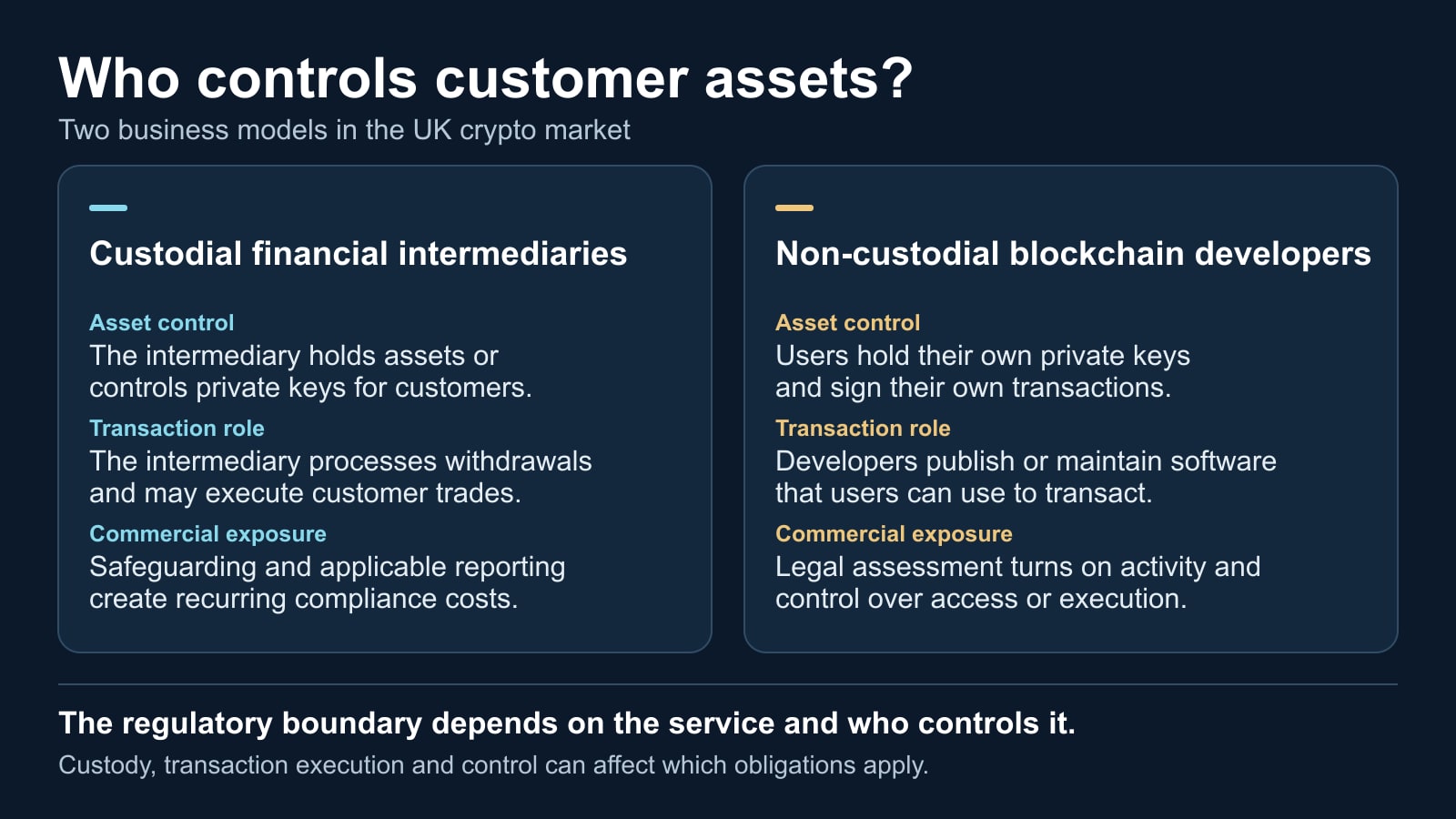
The distinction becomes clearer when different business models are compared. An issuer of a dollar-backed stablecoin such as USDC or USDT has reserve, redemption and counterparty obligations. A custodial exchange has responsibility for assets and withdrawals. An independent developer publishing software that never takes custody of funds presents a different set of risks.
Those activities should not be assumed to require identical controls. If the regulatory boundary is unclear, a developer may need specialist legal advice before knowing whether a service can be launched. The expense and uncertainty can matter as much as the eventual compliance obligation.
The decentralised exchange exposes the hardest boundary
A decentralised exchange can enable transactions between users who retain control of their own wallets. It does not necessarily operate the same way as an exchange that holds customer balances, processes withdrawals and controls the keys.
Yet decentralisation is not an exemption in itself. A website operator, developer company, governance group or other identifiable participant may still exercise control over important parts of the service. The practical question is what those parties do, rather than whether the product calls itself decentralised.
The FCA has recognised this issue. In October 2026 it consulted on guidance covering exclusions for certain technical services that merely provide access to third-party services or decentralised protocols. A parallel consultation addressed operational resilience and financial crime risks where regulated firms use decentralised finance.
This matters because it demonstrates that the UK has not ignored the difference between software and financial intermediation. The remaining test is whether the distinction becomes clear enough to apply without disproportionate expense or legal uncertainty.
HMRC's reporting framework and the FCA's regulatory perimeter also serve different purposes. A technical service falling outside one regime should not automatically be assumed to fall outside every tax or reporting obligation. For a small business, navigating those overlapping definitions can itself become a barrier to entry.
International competitors are making different choices about the same problem
The UK's tax reporting requirements are not an isolated national initiative. The European Union's DAC8 rules began applying from January 2026 and similarly expand reporting of cryptoasset transactions. The OECD framework is being adopted across multiple jurisdictions.
That weakens any argument that British customers alone are being subjected to tax identification requirements. A business moving to another participating country may encounter comparable obligations.
There are, however, meaningful differences in how governments define the responsibilities of decentralised operators. In the United States, Congress overturned an Internal Revenue Service rule that would have extended broker reporting to certain decentralised finance participants. Other digital asset reporting obligations remain in place.
The contrast illustrates a policy choice about who can reasonably be required to identify customers and report transactions. A conventional intermediary ordinarily has customer relationships and account records. Software that enables transactions without taking custody may not have access to equivalent information.
Comparing countries according to whether their governments are socialist, authoritarian or liberal would not resolve this question. Democratic states have adopted extensive reporting systems, while more centralised states can support selected blockchain applications and restrict independent cryptoasset activity. For businesses deciding where to invest, the practical variables are the cost and predictability of compliance, access to banking and capital, enforceable property rights and the ability to operate a viable product.
High energy costs compound a narrower infrastructure disadvantage
The UK's electricity costs add another constraint, particularly for energy-intensive activities. Government data for 2024 placed UK industrial electricity prices at the highest level among the reporting IEA countries.
For Bitcoin mining, electricity is a central operating expense. High prices can materially weaken the economics of running mining equipment in Britain relative to jurisdictions with cheaper power.
The same claim cannot be applied indiscriminately to blockchain development. Writing smart contracts or building a decentralised application is not comparable to operating an industrial mining facility. Developers are more likely to be influenced by specialist skills, investment, tax treatment, banking access and the regulatory position of their intended business.
The UK therefore faces distinct competitiveness questions. Energy costs affect the location of some physical infrastructure. Regulatory and financing conditions affect where software businesses form and grow. Combining them into a general claim that all blockchain innovation is uncompetitive would obscure the mechanisms that policymakers could address.
Industry representation must include businesses that do not yet exist
Industry organisations, including CryptoUK and the British Blockchain Association, have participated in policy debate, education and engagement with government. It would be inaccurate to suggest that the sector has lacked representation or that its associations have been silent.
The more useful test concerns whose interests shape the eventual rules. An established custodian wants a reliable authorisation process and a regulatory framework that reassures clients. A small software developer may be more concerned with knowing whether publishing an interface or operating a protocol creates regulated obligations.
Those priorities are not mutually exclusive, but neither are they identical. An industry agenda dominated by the requirements of established exchanges and financial institutions may overlook the circumstances in which the next generation of businesses begins.
Small teams and independent developers have played a significant role in the wider technology economy. Open-source blockchain projects can similarly begin without substantial capital, an established customer base or institutional backing. Many will fail. Some may create software and infrastructure that later supports much larger markets.
The commercial question for industry associations is whether their engagement produces clear, workable distinctions for these early-stage participants, rather than regulatory certainty only for firms already able to finance compliance.
The political history is more complicated than a change of government
Sunak's 2022 announcement explicitly connected effective regulation with the ambition to attract investment and innovation. Much of the subsequent framework was developed under Conservative administrations, before Labour continued its implementation.
The evidence therefore does not support describing the current regime as a simple reversal imposed by Labour, or attributing a deliberate effort to suppress cryptocurrency to the civil service. Financial promotions, custody, fraud and market abuse presented genuine policy problems before the change of government.
The stronger criticism concerns the cumulative outcome of decisions taken across governments and regulators. A series of individually defensible measures can create a market in which compliance costs and uncertainty favour established firms. That effect can occur without any single institution intending to disadvantage smaller developers.
It is also possible for a more predictable regime to attract investment and support some new businesses. The point is to measure which kinds of activity benefit, which face greater costs and whether opportunities are being lost before they become visible in official industry statistics.
The measure of success is who can enter the market
A growing institutional digital asset sector would generate commercial activity, investment and demand for specialist services. It would not, by itself, demonstrate that the UK had become an attractive place to develop decentralised technology.
A more complete assessment would examine early-stage company formation, the cost of regulatory advice, access to bank accounts, investment in independent developers, the survival of new projects and the location of the intellectual property and revenues they create.
HMRC's reporting regime and the FCA's expanding perimeter are important because they help determine which businesses can operate economically. Their success should be judged not only by the compliance standards achieved, but also by whether obligations remain proportionate to the risks and functions of different participants.
The UK can build a credible institutional market for cryptoassets while still failing to capture the commercial value of the infrastructure developed around them. Whether that happens will depend on how effectively its rules distinguish custody and financial intermediation from software development.
The enduring test of the 2022 crypto-hub ambition is whether the next generation of blockchain businesses can afford to begin in Britain.
Sources
- HM Treasury: UK cryptoasset technology hub announcement
- HMRC: Information required from cryptoasset users
- HMRC: Reporting cryptoasset user and transaction data
- FCA: Cryptoasset perimeter guidance consultation, October 2026
- FCA: Decentralised finance guidance consultation
- European Commission: DAC8
- US Internal Revenue Service: Revocation of DeFi broker reporting rule
- UK Government: Industrial electricity price comparisons
Related reading
Intelligence ·
Polygon licences and Samsung Wallet plans widen stablecoin distribution
Stablecoins and tokenised assets are moving beyond blockchain-native venues into licensed payment networks, mobile wallets and institutional products. The emerging competitive advantage is distribution and regulatory access, although security and asset integrity remain material constraints.
Commentary ·
Quest Colossus proposes crypto cards to bypass Visa and Mastercard
A new crypto initiative called Quest Colossus is attempting to bypass Visa and Mastercard with KYC-less payment cards, highlighting the growing tension between decentralised finance and the compliance infrastructure of global card networks.
Intelligence ·
Visa and Mastercard expand stablecoin payment infrastructure
Stablecoin adoption is shifting towards regulated payment infrastructure as card networks, banks and enterprise providers move from experimentation to deployment. The change strengthens distribution and compliance as sources of competitive advantage, while placing pressure on issuer economics.
Intelligence ·
French lawmakers back a tax on crypto-to-stablecoin gains
French lawmakers’ approval of a 31% capital-gains charge on crypto-to-stablecoin trades moves taxation into the digital-asset transaction chain. Alongside expanding reporting requirements, the measure shows that national tax rules can materially alter customer economics even when market access is already regulated.