



Going long or short in crypto: spot, margin and perpetuals
Trading Essentials Series 4 of 6
Understand long and short exposure, borrowing, leverage, perpetual funding and how a contract differs from owning the crypto.
Only put money into crypto that you can afford to lose in full. This guide is for education and is not personal financial advice. Do your own research into the asset, platform, fees and risks before making a decision.
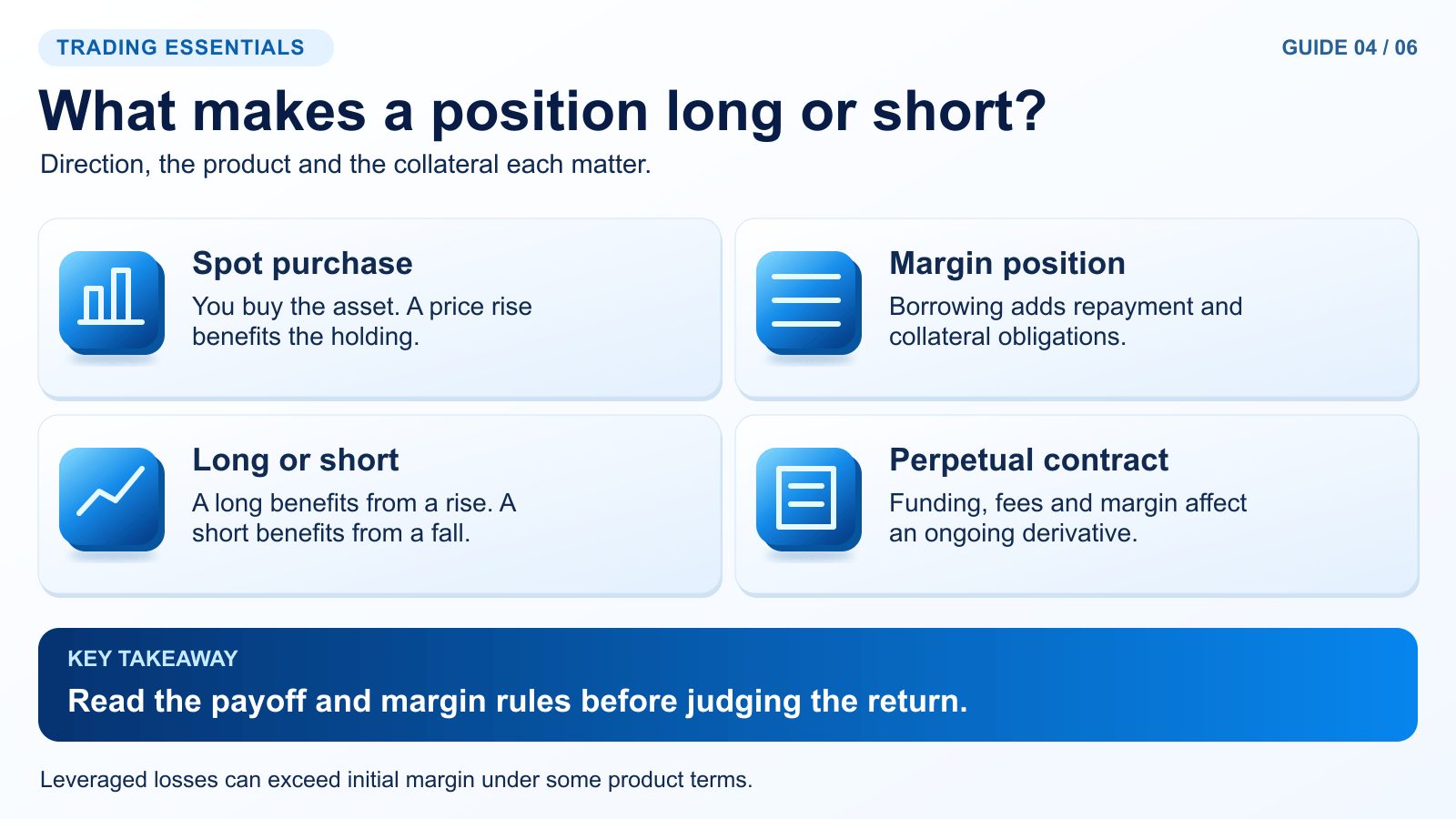
Read the infographic as text
What makes a position long or short?
Direction, the product and the collateral each matter.
- Spot purchase
- You buy the asset. A price rise benefits the holding.
- Margin position
- Borrowing adds repayment and collateral obligations.
- Long or short
- A long benefits from a rise. A short benefits from a fall.
- Perpetual contract
- Funding, fees and margin affect an ongoing derivative.
Key takeaway: Read the payoff and margin rules before judging the return.
Leveraged losses can exceed initial margin under some product terms.
View the worked example and calculation
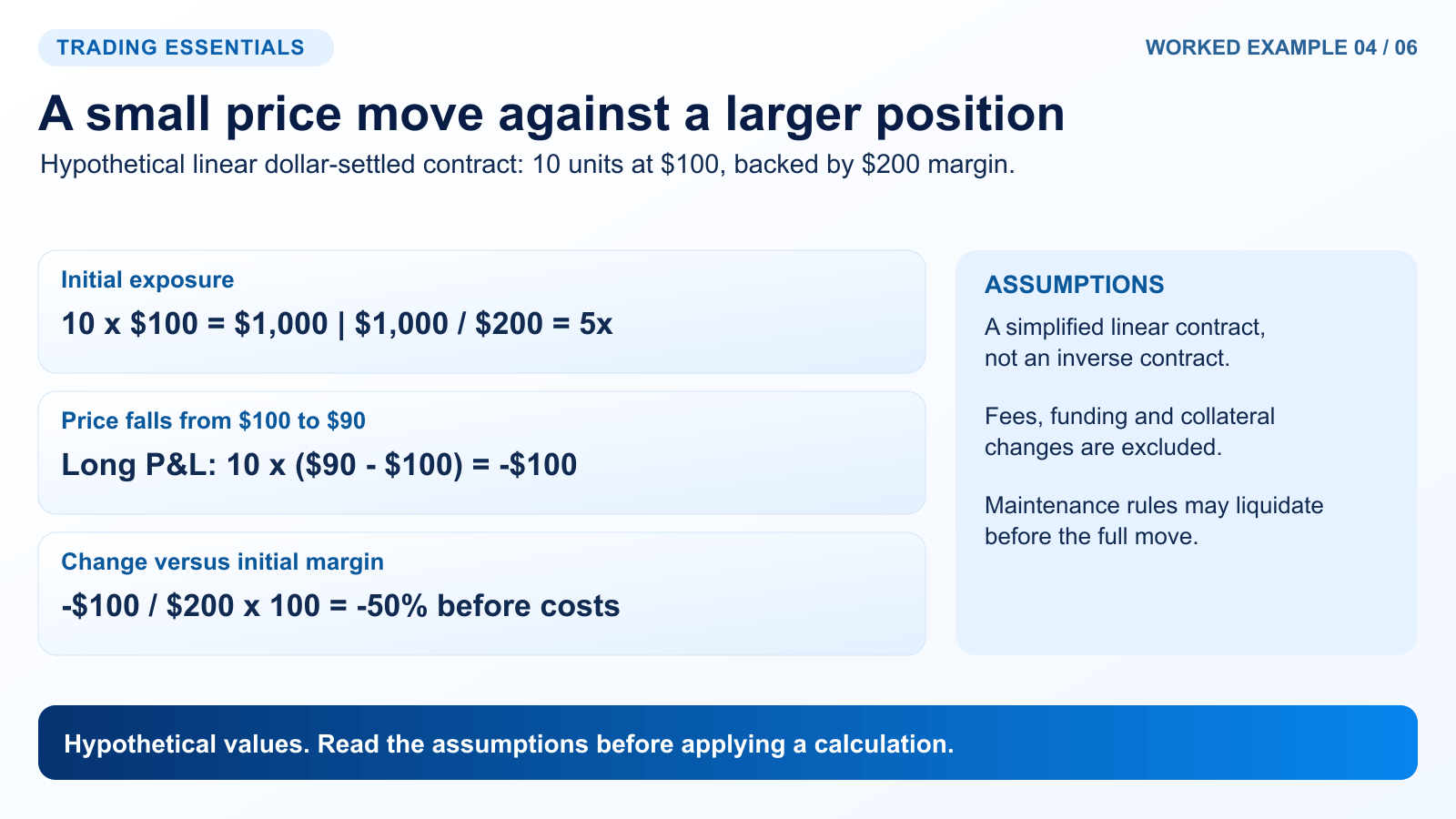
A small price move against a larger position
Hypothetical linear dollar-settled contract: 10 units at $100, backed by $200 margin.
- Initial exposure
- 10 x $100 = $1,000 | $1,000 / $200 = 5x
- Price falls from $100 to $90
- Long P&L: 10 x ($90 - $100) = -$100
- Change versus initial margin
- -$100 / $200 x 100 = -50% before costs
A simplified linear contract, not an inverse contract.
Fees, funding and collateral changes are excluded.
Maintenance rules may liquidate before the full move.
Buying a coin and opening a position that profits when its price rises can look similar on a trading screen. The product behind the position determines whether you hold the asset, owe a loan or have a contract whose value changes with the market.
Borrowing and leveraged derivatives can create losses beyond your initial margin, depending on the product, account and protections available. Access also varies by country and customer type. Read the actual contract and local eligibility rules before considering any leveraged trade.
Start with what long and short describe
A long position benefits from a rise in the relevant price and loses from a fall. A short position benefits from a fall and loses from a rise. Those words describe direction. They do not identify the product used to obtain it. A fully paid spot purchase gives you long exposure without a loan. A long perpetual contract gives price exposure under a derivative’s terms. A short can be established through borrowing and selling an asset or through a derivative position.
For a simple spot illustration, buying two SOL at a hypothetical $100 each costs $200 before fees. Selling them at $110 would produce $220, a $20 gain before costs. Selling at $90 would produce $180, a $20 loss. Keeping SOL on an exchange leaves you dependent on its custody arrangements. Our ownership guide explains why holding the asset and holding its keys are separate questions.
Borrowing introduces a repayment obligation
In a simplified margin short, imagine borrowing two units of an asset and selling them for $100 each. You receive $200 but still owe two units plus the applicable costs. If you later buy two units at $90 each to repay the loan, the price difference is a $20 gain before borrowing charges and trading fees. If you must repurchase at $120, the difference is a $40 loss. The borrowed quantity is what needs repaying. A much higher price can make the obligation far more expensive.
A margin long can use financing to buy more of an asset than the trader’s own contribution would otherwise cover. Collateral supports the obligation, and the venue can impose maintenance requirements. Interest, rollover charges and restrictions on eligible assets vary. Read whether the provider lends the base asset, quote currency or uses another financing arrangement. Kraken’s margin explanation sets out its own model. Kraken margin trading overview
A perpetual is a contract with continuing costs
A perpetual typically lets a trader take exposure to an asset price without owning the underlying coin and without a fixed expiry. Many crypto venues use periodic funding payments between long and short positions to help keep the contract near its reference market. A positive funding rate commonly means longs pay shorts, with negative funding reversing that direction. The formula, rate limits and settlement times are contract-specific. The product’s risk documents are the authority for the instrument you are considering. Kraken explanation of perpetual contracts
Suppose a hypothetical linear, dollar-settled contract represents ten units at an entry price of $100, giving $1,000 of initial exposure. A $10 fall means a $100 loss for the long and a $100 gain for the short, before fees and funding. If a trader posted $200 of margin, that $100 change equals half the starting margin. This is arithmetic for a simplified linear contract. Contracts settled in crypto or with inverse payoff rules require different calculations.
If the illustrative funding rate is 0.01% per interval and the assessed position value is $1,000, the payment is $0.10 for that interval. Repeating the rate is an assumption, not a forecast. Funding can change direction or size, and price movements can change the value on which it is calculated. Check when a payment applies rather than assuming every holding period carries the same charge.
Margin is a buffer the venue can require you to replenish
Initial margin is the collateral needed to open exposure. Maintenance margin is what the venue requires to keep it open. A platform can begin reducing or liquidating a position before the initial contribution has been exhausted. Valuation prices, costs, collateral movements and other positions can affect the trigger. An isolated-margin arrangement allocates a specified margin balance to a position, subject to its rules. Cross margin can draw on shared account collateral, making other balances relevant. Check automatic additions and deficit rules as well as the label.
The liquidation price displayed on screen is an estimate under specified conditions. Funding charges or a fall in crypto collateral can change the position even if the contract’s last-traded price barely moves. A stop order also depends on its trigger and execution, so it cannot make liquidation or losses impossible. The existing liquidation guide explains how forced closures can reach the wider market.
Before interpreting an apparent profit, identify the asset or contract, the position quantity, collateral, borrowing or funding costs and exit conditions. A green number attached to a leveraged position can conceal how little adverse movement the account can withstand.
Sources
Related reading
Intelligence ·
CFTC stock perpetual approval draws lawsuit from Citadel Securities-backed group
The CFTC’s clearance of stock-linked perpetual futures brings a contract design popularised by crypto into US equity markets. A prompt legal challenge from a Citadel Securities-backed group leaves the product’s regulatory classification and launch conditions unsettled.
Intelligence ·
ETF inflows support Bitcoin’s recovery as yields and leverage test the rally
Crypto’s fortnightly recovery was supported by substantial ETF inflows after an abrupt policy and rates-driven reset, while short liquidations amplified the advance. The subsequent retreat below $84,000 shows that regulated demand is cushioning volatility rather than insulating Bitcoin from macroeconomic pressure.
Commentary ·
How leverage and liquidity drove the Bitcoin sell-off
The recent Bitcoin sell-off was driven by leverage, liquidity mechanics, and forced positioning rather than a shift in long-term conviction.
Guides ·
Market, limit and stop orders explained
Understand how crypto order types control price and execution, why stops can slip and what a partial fill means for your balance.