



How cryptocurrency and blockchain work together
Crypto Essentials Series 1 of 6
Learn how a blockchain records cryptocurrency, why networks need consensus and what separates a native coin from a token.
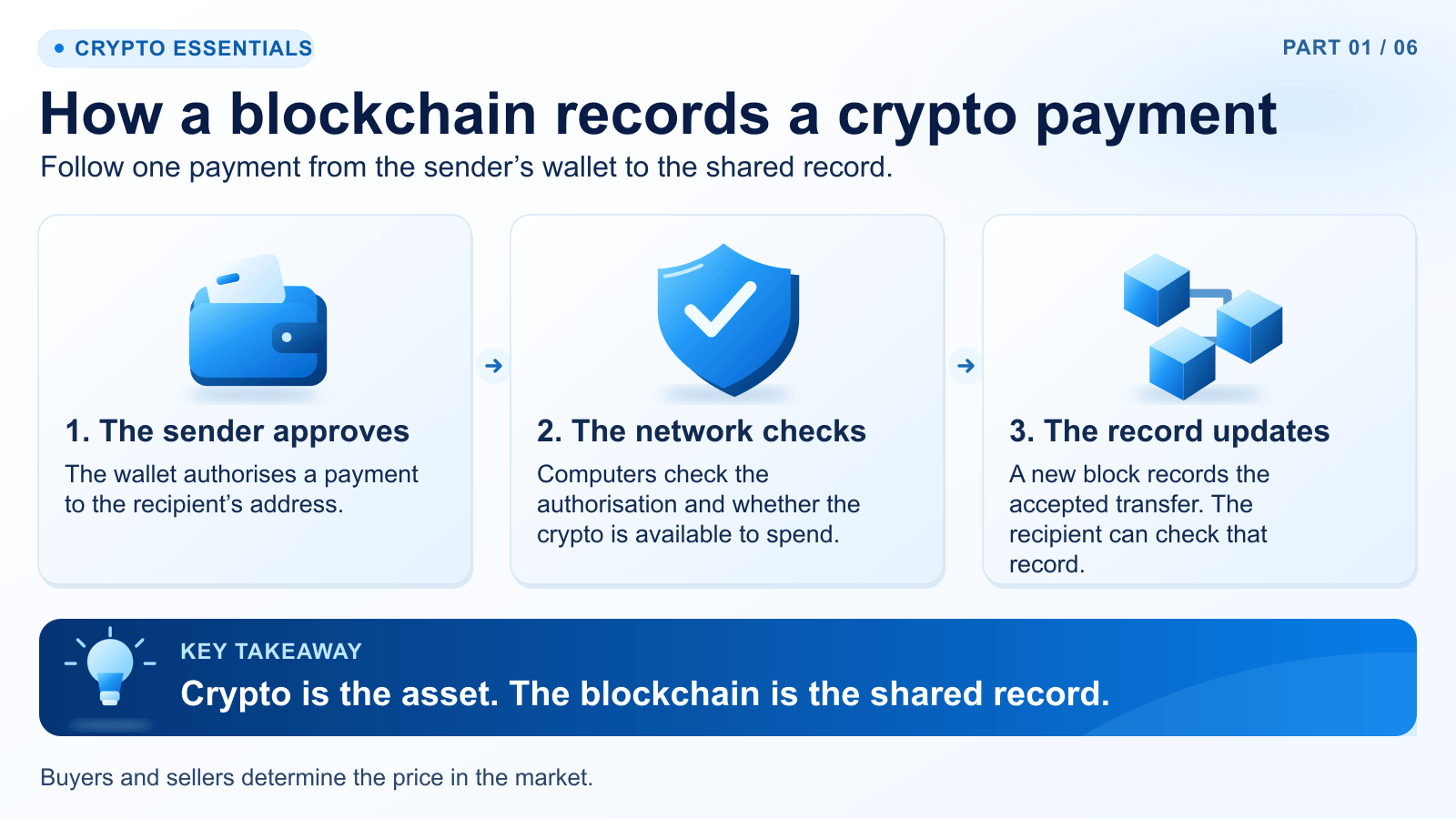
Read the infographic as text
How a blockchain records a crypto payment
Follow one payment from the sender’s wallet to the shared record.
- 1. The sender approves
- The wallet authorises a payment to the recipient’s address.
- 2. The network checks
- Computers check the authorisation and whether the crypto is available to spend.
- 3. The record updates
- A new block records the accepted transfer. The recipient can check that record.
Key takeaway: Crypto is the asset. The blockchain is the shared record.
Buyers and sellers determine the price in the market.
Cryptocurrency is a digital asset you can send over a network. When a payment goes through, the network adds it to a shared record called a blockchain.
Who keeps the record when there is no bank?
When you pay someone through your bank, the bank updates its records. You trust it to keep those records accurate and stop you spending the same money twice.
Bitcoin uses a different arrangement. Many computers around the world keep copies of its transaction history and check new transactions against a common set of rules. No single bank decides which payments count.
A blockchain is the record these computers maintain. New transactions are collected into groups called blocks. Each block refers to the previous one, linking them together in order.
The important idea is not the shape of a block. It is that independent computers can check the same history and agree which Bitcoin is available to spend.
Why can't somebody spend the same Bitcoin twice?
Suppose someone sends Bitcoin to a shop and then tries to send that same Bitcoin elsewhere. The network needs to decide which payment is accepted.
Bitcoin transactions are authorised using private keys, which are secrets controlled through wallets. A valid authorisation shows that a payment was approved by the holder of the relevant key. It does not mean the money is still available if it has already been spent.
Computers called full nodes check transactions and blocks against Bitcoin's rules. A transaction attempting to spend Bitcoin that has already been spent cannot become valid simply because somebody asks for it.
The network also needs a way to agree on the order of valid transactions when different computers hear about them at different times. Bitcoin uses a system called proof of work. Miners compete to add blocks, and nodes follow the valid chain with the most accumulated work. The Bitcoin Developer Guide explains these checks.
Our guide to miners and validators explains how networks reach agreement without a central operator.
What is the difference between Bitcoin and blockchain?
Bitcoin is both the name of a network and the everyday name of its cryptocurrency. The abbreviation BTC is used when prices and balances are quoted.
The blockchain is the record that Bitcoin's network maintains. It is the system's infrastructure, not a separate coin you need to buy.
Ethereum is another blockchain network. Its native cryptocurrency is called ether, abbreviated ETH. Ethereum can also run programmes known as smart contracts. These programmes follow instructions recorded on the network, such as managing a digital token. Ethereum's account documentation explains how its accounts work.
A blockchain can exist without being Bitcoin, and different blockchains have different rules and uses.
What is a coin and what is a token?
A coin usually means a cryptocurrency native to its own network. Bitcoin belongs to the Bitcoin network; ether belongs to Ethereum.
A token is often created using an existing blockchain. For example, developers can create tokens on Ethereum using smart contracts instead of building a new blockchain from scratch.
That distinction matters when you send money. Two tokens may have similar names, and a token can exist on several networks. The name alone is not enough to identify what you are receiving.
When a wallet or exchange asks which network you want to use, it is asking which blockchain should record the transfer. Choosing the wrong one can leave the recipient unable to access the funds. Ethereum's ERC-20 documentation explains one common token standard.
Does a blockchain make cryptocurrency safe?
A blockchain can make its transaction history publicly checkable. It cannot guarantee that the cryptocurrency will hold its market value, that a company backing a token has enough reserves, or that an exchange will return customer assets.
Bitcoin's network can record a valid payment even if the person who sent it was tricked into doing so. A public record also does not make every user anonymous: transactions and addresses may be visible, and those addresses can sometimes be linked to real people.
The technology addresses a particular problem: maintaining and verifying a shared record. It does not solve every financial, legal or security problem surrounding the asset.
Why does cryptocurrency have a price?
People buy and sell cryptocurrencies on markets. Their prices depend on what buyers are willing to pay and sellers are willing to accept.
Bitcoin's blockchain records quantities of Bitcoin, not a guaranteed value in pounds. If the market price falls, the same amount of Bitcoin is worth less in sterling even though the network's record remains accurate.
An exchange can also show a cryptocurrency balance on its own internal records without recording every customer trade separately on the blockchain. That is why the balance shown in an app and the question of who controls the actual cryptocurrency are different matters. Our ownership guide explains that distinction.
Understanding cryptocurrency begins with three separate ideas: the blockchain keeps the shared record, the cryptocurrency is the asset being transferred, and the market determines what that asset is worth.
Sources
Related reading
Commentary ·
Governments and institutions narrow their choice of blockchain networks
Governments and large institutions are no longer piloting blockchain in the abstract. They are deploying specific networks for payments, identity, records, and public infrastructure, quietly narrowing adoption to chains that meet real-world operational and governance requirements.
Intelligence ·
Polygon licences and Samsung Wallet plans widen stablecoin distribution
Stablecoins and tokenised assets are moving beyond blockchain-native venues into licensed payment networks, mobile wallets and institutional products. The emerging competitive advantage is distribution and regulatory access, although security and asset integrity remain material constraints.
Guides ·
How stablecoin payments work — and where the costs remain
A blockchain transfer is one stage of a payment. Conversion, redemption and local banking determine what the recipient can actually spend and when.
Guides ·
What do you actually own when you buy a tokenised share?
A token can represent a company share, a claim through an intermediary or a product tracking the price. The legal rights matter more than the ticker or blockchain.