



Proof of work vs proof of stake: miners and validators explained
Crypto Essentials Series 4 of 6
Learn why Bitcoin, Litecoin and Monero use mining, how Ethereum, Solana and Cardano use stake, and why confirmation rules differ.
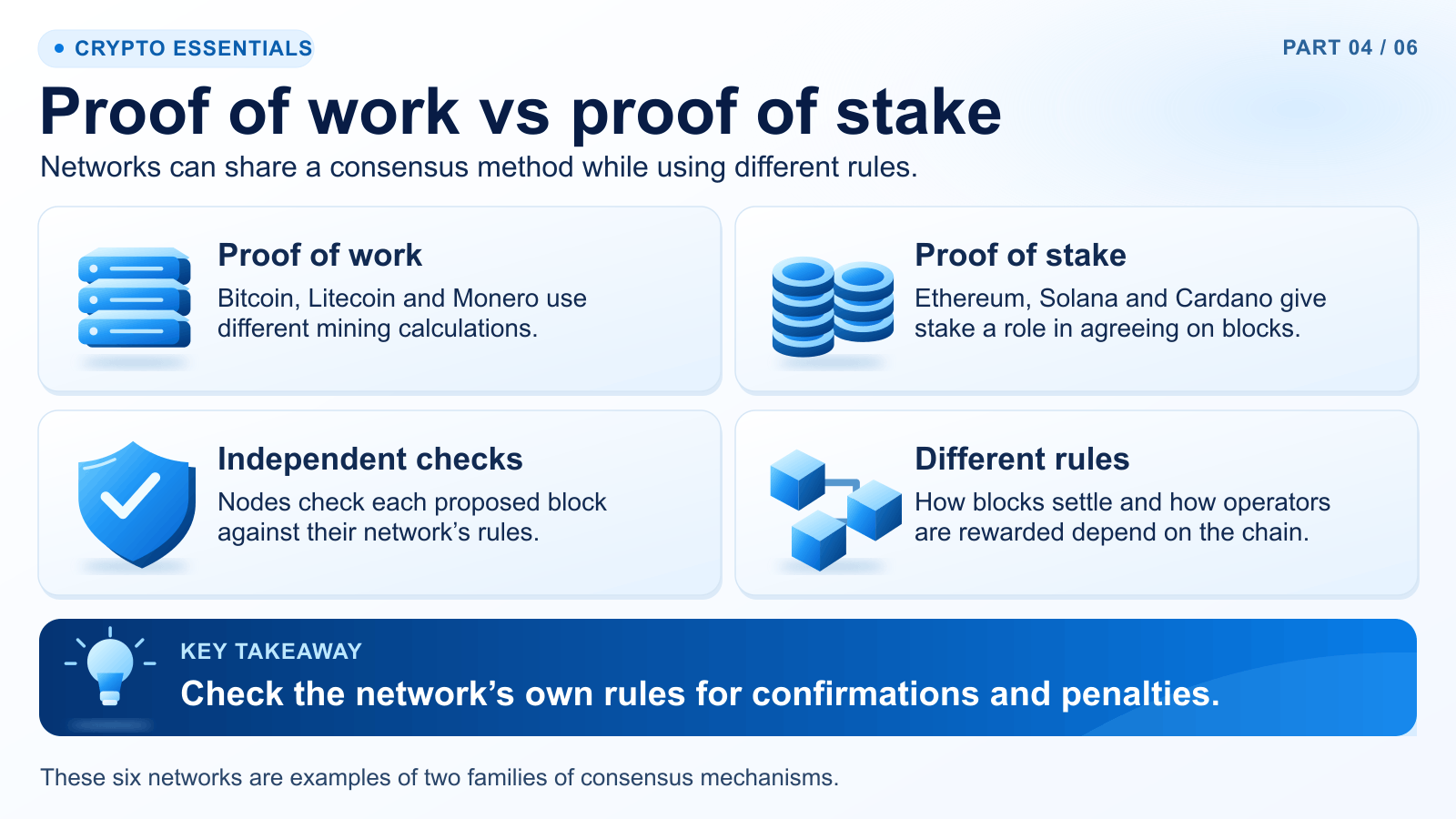
Read the infographic as text
Proof of work vs proof of stake
Networks can share a consensus method while using different rules.
- Proof of work
- Bitcoin, Litecoin and Monero use different mining calculations.
- Proof of stake
- Ethereum, Solana and Cardano give stake a role in agreeing on blocks.
- Independent checks
- Nodes check each proposed block against their network’s rules.
- Different rules
- How blocks settle and how operators are rewarded depend on the chain.
Key takeaway: Check the network’s own rules for confirmations and penalties.
These six networks are examples of two families of consensus mechanisms.
Picture two shops receiving payment instructions that try to spend the same funds. Both might have the right signature, but the network needs to agree which payment to accept. Proof of work and proof of stake solve that problem in different ways, and networks within each family set their own rules.
Who gets to put the next block together?
Thousands of computers can check a payment. The harder question is who gets to put a batch of payments into the shared record and how everyone else decides to accept it. If two otherwise valid blocks arrive at about the same time, different computers may see them in a different order. A set of rules called consensus helps the network converge on a common history. Every proposed block still has to pass the network’s checks, including whether the sender was authorised to spend the funds and whether those funds were still available.
On a proof-of-work network such as Bitcoin, miners repeatedly run a calculation on a proposed block until one finds a result that meets the network’s target. Finding it takes many attempts. Other computers can check it quickly. Bitcoin’s nodes follow the valid chain with the most accumulated work, so a person trying to replace a recent payment must produce a competing valid history that overtakes it. A successful Bitcoin miner can collect transaction fees and a block subsidy, which consists of newly issued bitcoin. That revenue has to cover equipment, electricity and operating costs. Bitcoin’s developer guide explains the work and the reward.
Litecoin uses a calculation called Scrypt. Monero uses RandomX. Both are proof-of-work networks, but the work a miner performs is different. Hardware and mining economics on one chain therefore tell you little about the cost of competing on another.
Proof of stake gives validators influence through stake
A proof-of-stake network uses the cryptocurrency committed to the system to help decide who proposes blocks or how much weight a validator’s vote carries. Ethereum assigns validators to propose blocks and vote on the chain. Votes representing at least two-thirds of active stake are needed to finalise the relevant checkpoints. Ethereum can take part of a validator’s stake for certain serious offences, such as signing conflicting votes. That penalty is called slashing. Missed duties can bring different penalties. Ethereum’s proof-of-stake documentation sets out the distinction.
Solana also weights validators’ votes by stake. People can delegate SOL to a validator, adding to the stake behind its vote. Cardano uses Ouroboros, which selects stake pools to make blocks based on the stake they control. The three networks share the idea of giving stake a role in consensus. Each decides how blocks are proposed and accepted, what penalties apply and when participants can withdraw. Solana’s validator documentation and Cardano’s Ouroboros overview describe their respective approaches.
What the difference means when you use the network
A shop receiving a Bitcoin payment may wait for additional blocks to build on the one containing the payment. Each one adds work that a competing history would need to overtake. On Ethereum, the shop can also check whether the block containing the payment has been finalised under the protocol. An exchange receiving either asset can set its own conditions for crediting the deposit. That’s why a transfer can appear on the blockchain before it shows in your account.
If an app offers to stake crypto for you, read the app’s terms alongside the rules of that network. The protocol governs how validators earn rewards and what penalties they face. The app’s terms explain what share of the rewards you receive, how you get your assets back and who bears a loss if the validator it uses is penalised.
Sources
Related reading
Intelligence ·
Solana’s Alpenglow launch tests validator readiness
Solana activated a new consensus engine after validators representing 20.3% of stake were assessed as unprepared, while XRP Ledger postponed a fix when validator backing weakened. The developments make release coordination, rather than theoretical speed alone, a central measure of network performance.
Intelligence ·
Stablecoin supply drops $6.7 billion as Bitcoin falls below $75,000
The steepest weekly stablecoin contraction reported in 2026 coincided with Bitcoin falling below $75,000 and a roughly $200 billion decline in altcoin market value. A short-liquidation rally and Bitcoin sales by miners show why Binance’s recapitalisation has not yet translated into a broad market recovery.
Commentary ·
How Strategy uses capital markets to finance Bitcoin purchases
Strategy's Bitcoin accumulation strategy is less about corporate conviction and more about transforming capital markets into a financing engine for Bitcoin acquisition.
Commentary ·
How leverage and liquidity drove the Bitcoin sell-off
The recent Bitcoin sell-off was driven by leverage, liquidity mechanics, and forced positioning rather than a shift in long-term conviction.