



What happens when you send cryptocurrency?
Crypto Essentials Series 5 of 6
Follow a crypto transfer from sender to recipient. Understand network and withdrawal fees, check the address, and know what to do if it goes wrong.
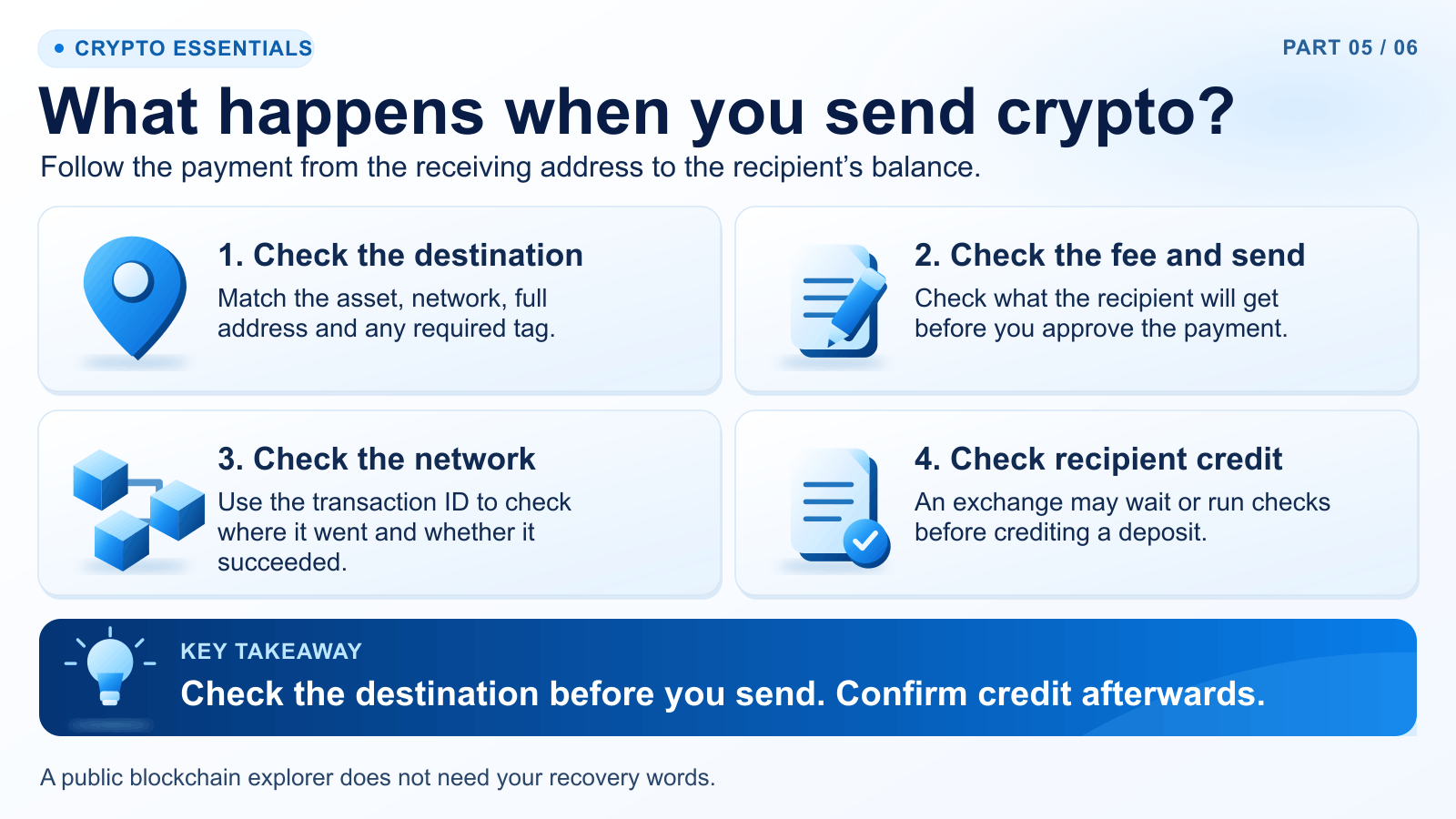
Read the infographic as text
What happens when you send crypto?
Follow the payment from the receiving address to the recipient’s balance.
- 1. Check the destination
- Match the asset, network, full address and any required tag.
- 2. Check the fee and send
- Check what the recipient will get before you approve the payment.
- 3. Check the network
- Use the transaction ID to check where it went and whether it succeeded.
- 4. Check recipient credit
- An exchange may wait or run checks before crediting a deposit.
Key takeaway: Check the destination before you send. Confirm credit afterwards.
A public blockchain explorer does not need your recovery words.
Your wallet can say ‘Sent’ while the person you’re paying still sees nothing. A crypto transfer has three roles: someone sends it, the network checks and records it, and someone receives it. If an exchange is involved, it may do some of that work for either person.
Who does what in a transfer?
Say Priya wants to send a token to a friend. Her friend provides an address for that token on a particular network. Priya’s wallet prepares the payment, uses her private key to authorise it when she taps Send and passes it to the network. Computers on the network check the instruction against their rules and, if it succeeds, record the transfer in a block. The network is the third participant in this sense. It is a system run by many computers, rather than a person holding the money in between. Ethereum’s transaction documentation describes how those steps work on one network.
With an exchange, a withdrawal starts as a request to the provider. The exchange signs and sends the transaction when it processes that request. A receiving exchange may also hold the incoming payment while it waits for confirmations or runs its own checks. A ‘pending’ message can therefore describe a request that has yet to leave the exchange or a transaction that is already on its way.
Check the fee and what the recipient will get
A network fee is the charge for processing the transaction under that blockchain’s rules. On some networks, a higher fee can improve the chance that a transaction is included sooner when space is tight. Ethereum mainnet measures the work in gas, typically paid in ETH even when you send another token. Solana charges in SOL and has a base fee plus an optional fee for priority. If you’re sending a token from your own wallet, check what currency you need for the fee before you start. Ethereum explains gas and fees. Solana sets out its fee structure.
An exchange may quote a separate withdrawal fee. Read the confirmation screen for the amount the recipient will get. If the service deducts a one-unit fee from a request for 50 units, the recipient gets 49. If it charges that fee separately, the recipient gets 50 and your account is debited for 51. If the recipient has a minimum deposit, compare it with the amount that will actually arrive.
A valid address can still be the wrong address
If you’re sending, get the address directly from the recipient and compare the full address with what your wallet shows before you approve. A scammer can plant a lookalike address in your transaction history, so get the address from the original source each time. MetaMask explains how that scam works.
If you’re requesting payment, open the receive screen for the exact asset and network you want, then share those details together. An exchange may also give you a memo or destination tag that identifies which customer to credit at a shared address. The XRP Ledger documentation shows how a tag does that job. For an unfamiliar route, try a small payment that meets any minimum and wait for the recipient to confirm it arrived.
A wallet may reject an address with an invalid format, but a valid address belonging to somebody else can still receive the payment. Once that transfer is confirmed, the sender generally cannot cancel it. If you know who controls the destination, ask them to return it. If you used an unsupported network or missed a required tag, contact the receiving service through its verified support channel. Give it the transaction ID, the network, the amount and the address. Recovery depends on who can access the destination and what the provider supports. Never give anyone your private key or recovery words.
Check the transaction before sending again
Look up the transaction ID in a trusted explorer for the network you used. You can read a public transaction without connecting a wallet. Check the destination and the result. A transaction included in a block can still have failed, and on some networks it can still cost a fee. If you find no result, check whether the sending service has broadcast it and whether you chose the right explorer. A delayed transaction can still go through, so sending a second one risks paying twice.
If the payment succeeded at the right address but the recipient’s exchange shows no credit, the receiving exchange can tell you what it still needs. If the recipient wants the proceeds in a bank account, selling the crypto and withdrawing the money are further steps. See our guide to buying and cashing out crypto.
Sources
Related reading
Guides ·
How to buy and cash out crypto safely
How to use crypto on-ramps and off-ramps, compare fees, check which services operate where you live and plan a safe withdrawal.
Guides ·
Crypto wallets explained: what they are, how they work and which type you need
A beginner's guide to crypto wallets, recovery phrases, private keys, hot and cold wallets, and what happens when you keep crypto on an exchange.
Guides ·
Who owns your crypto? Private keys and custody explained
Find out what you own when you buy crypto, which products let you withdraw it and how private keys give you control of your own wallet.
Guides ·
How stablecoin payments work — and where the costs remain
A blockchain transfer is one stage of a payment. Conversion, redemption and local banking determine what the recipient can actually spend and when.