



How to buy and cash out crypto safely
Crypto Essentials Series 6 of 6
How to use crypto on-ramps and off-ramps, compare fees, check which services operate where you live and plan a safe withdrawal.
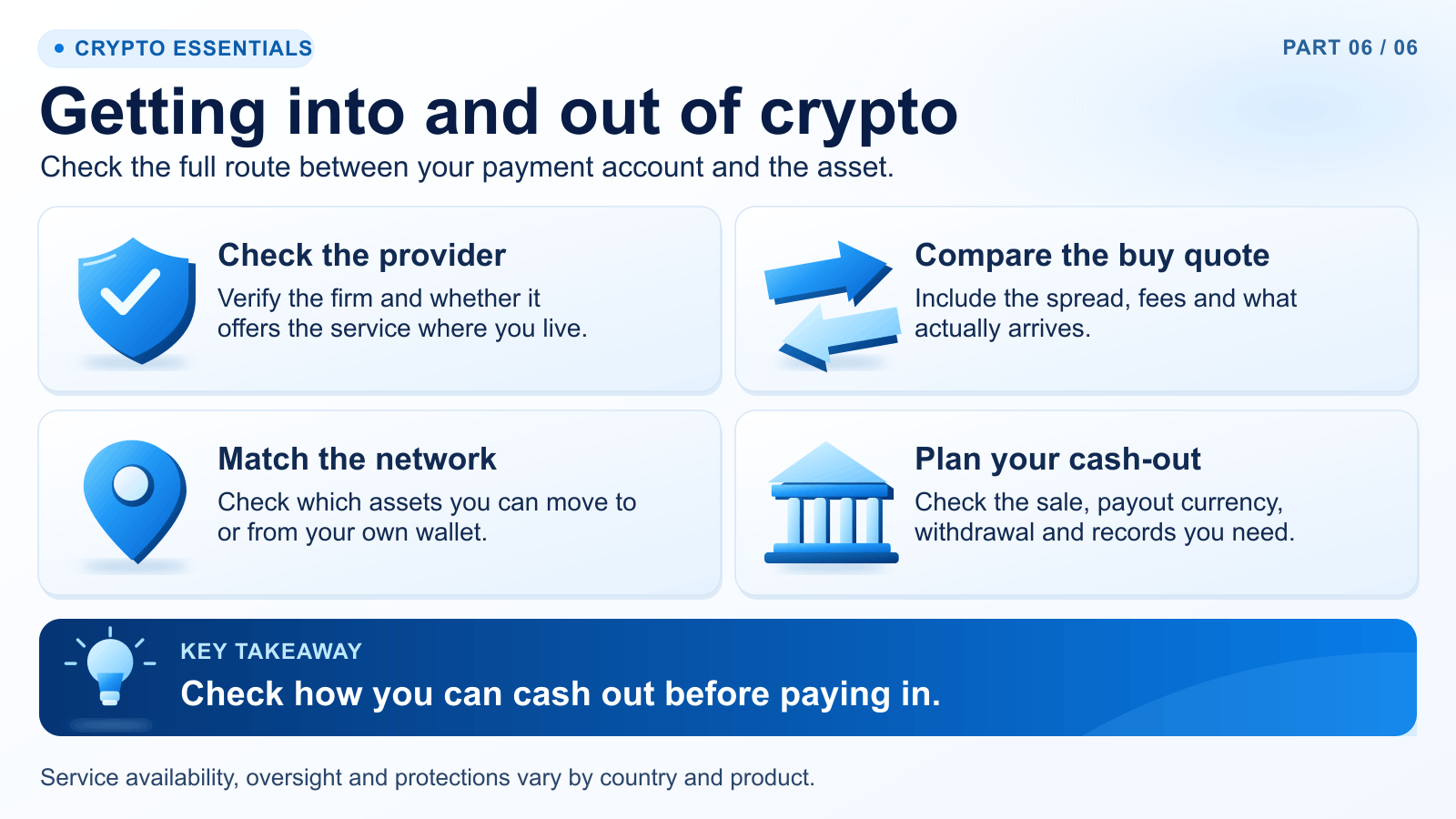
Read the infographic as text
Getting into and out of crypto
Check the full route between your payment account and the asset.
- Check the provider
- Verify the firm and whether it offers the service where you live.
- Compare the buy quote
- Include the spread, fees and what actually arrives.
- Match the network
- Check which assets you can move to or from your own wallet.
- Plan your cash-out
- Check the sale, payout currency, withdrawal and records you need.
Key takeaway: Check how you can cash out before paying in.
Service availability, oversight and protections vary by country and product.
An on-ramp lets you buy crypto with money from a bank account, card or other payment service. An off-ramp lets you sell crypto and get usable money back. Check both routes before you buy, because a service that accepts your payment may offer a different way to cash out.
Work backwards from what you want to do
If you want to send crypto from your own wallet, find out whether the service lets you withdraw the exact asset on a network your wallet supports. Some apps let you buy and sell a balance but offer cash withdrawals only. A broker may sell an investment that tracks crypto’s price instead. Those are different products even if their values move with the same market. The ownership guide explains how to tell them apart.
Then check who provides each service. A wallet might display a Buy button while a separate company takes your payment and delivers the crypto. Open the terms and find the legal name of the firm taking the money, who holds any balance and who handles complaints. Check whether that firm and product are available where you live, and use your local regulator’s official register where one exists. Check which activity any licence or registration covers and whether a complaint or compensation scheme applies to the product.
Compare the money paid with what you receive
Compare quotes for the same asset and network at roughly the same time. A provider may charge a visible fee and also build a margin into the quoted price. Include any charges for paying by card or bank transfer and any fee for moving the crypto to your wallet. Compare the final amount that arrives there if your plan is to hold it yourself.
Suppose one service charges $100 plus a $2 fee for 100 units of a token, then deducts two units when you withdraw. A second service charges $101 for 100 units and has no separate charge for this withdrawal. You receive 98 units for $102 on the first route and 100 units for $101 on the second. The figures are hypothetical. In a real comparison, check the quote and the withdrawal cost together before you confirm.
Selling and getting money back are separate steps
If the crypto is already in the provider’s account, you may be able to sell it there. If it’s in your own wallet, you will usually need to send it to a service that accepts the exact asset and network. Check the deposit minimum and whether the provider gives you a memo or tag as well as an address. A small test can limit the cost of a mistake, provided it meets the minimum. Wait for the service to credit the test before sending more. Our crypto transfer guide explains how to check where the payment has reached.
A completed sale can leave money in your account with the provider. Check which currencies and payout methods it supports, whether it can pay your bank or payment account, and what limits, fees or holds apply. A provider may ask who is sending or receiving crypto as part of checks required in its jurisdiction. The Financial Action Task Force tracks how countries apply these requirements, often called the Travel Rule. Use the provider’s verified site or app for any checks, and keep wallet keys and recovery words private.
Know when to stop and keep the records you’ll need
Use a unique password and enable the strongest second factor the service offers. Stop if somebody asks you to install remote access software, send money to a personal account or make an unexpected payment to unlock your proceeds. Verify any demand through contact details you found independently. If you suspect fraud, contact your bank or payment provider promptly and preserve the messages, receipts and transaction IDs. Offers to recover lost crypto for an upfront fee are a known follow-up scam. Investor.gov documents how advance-fee fraud works.
Download trade confirmations, fee records and payout statements while you still have access. Keep the date, asset, quantity, value in the currency you report in and any transaction ID that connects a transfer to a deposit or withdrawal. Ask your local tax authority which events you need to report. Keep records of sales and swaps as well as bank payouts, so you can reconstruct what happened and when.
Sources
Related reading
Guides ·
What happens when you send cryptocurrency?
Follow a crypto transfer from sender to recipient. Understand network and withdrawal fees, check the address, and know what to do if it goes wrong.
Guides ·
Who owns your crypto? Private keys and custody explained
Find out what you own when you buy crypto, which products let you withdraw it and how private keys give you control of your own wallet.
Guides ·
Crypto wallets explained: what they are, how they work and which type you need
A beginner's guide to crypto wallets, recovery phrases, private keys, hot and cold wallets, and what happens when you keep crypto on an exchange.
Commentary ·
Binance and Polymarket put their resources behind customer protection
Reimbursement promises reveal why crypto platforms absorb security losses, and where commercial incentives reach their limits as customer protection.