



What a stablecoin reserve attestation can and cannot tell you
BlockBeat Guides
A reserve report provides evidence within a defined scope and reporting date. Its conclusion does not guarantee continuous backing, issuer solvency or your ability to redeem.
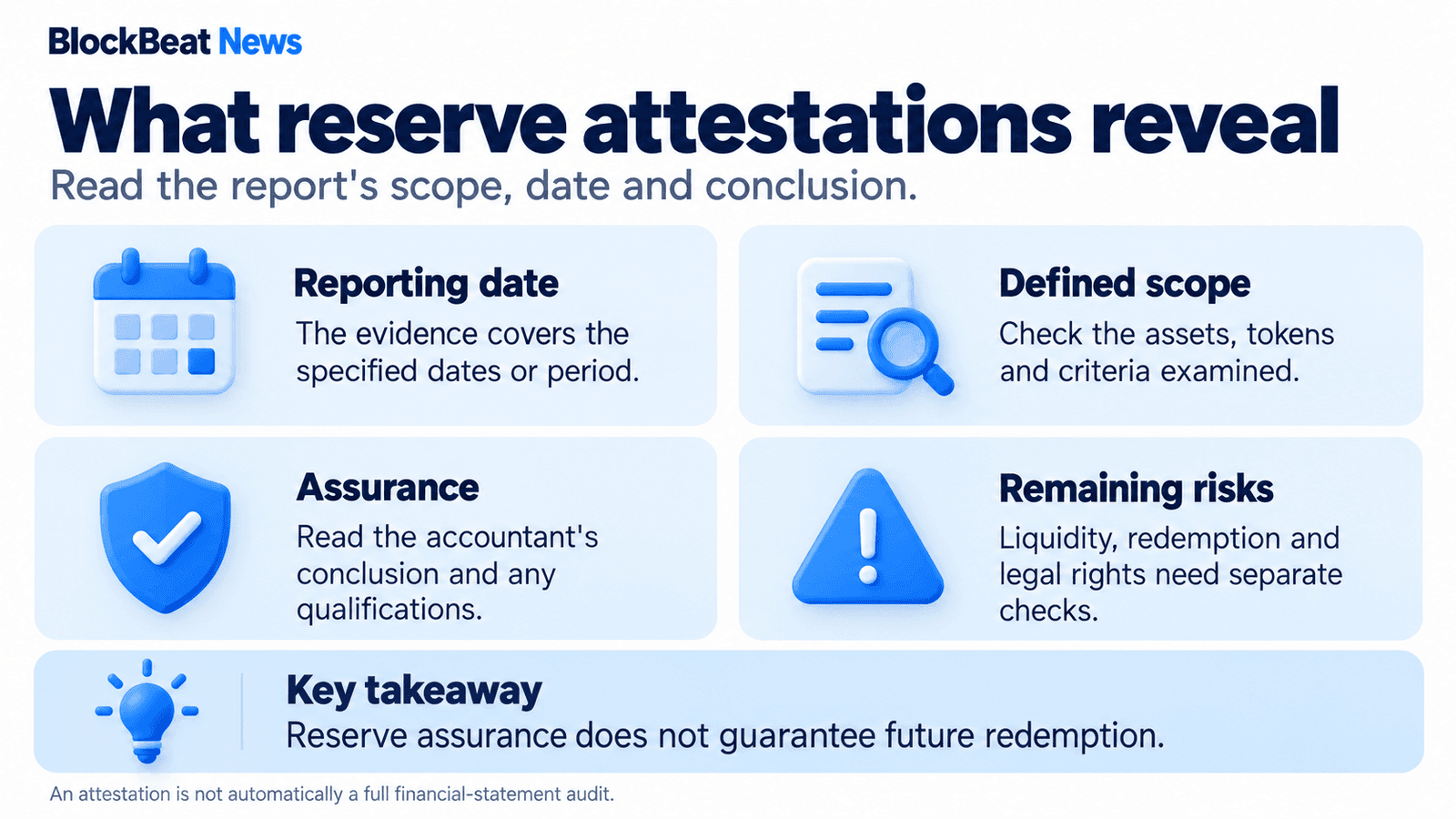
Read the infographic as text
What reserve attestations reveal
Read the report's scope, date and conclusion.
- Reporting date
- The evidence covers the specified dates or period.
- Defined scope
- Check the assets, tokens and criteria examined.
- Assurance
- Read the accountant's conclusion and any qualifications.
- Remaining risks
- Liquidity, redemption and legal rights need separate checks.
Key takeaway: Reserve assurance does not guarantee future redemption.
An attestation is not automatically a full financial-statement audit.
A stablecoin reserve attestation can support a specific statement about assets backing tokens at stated dates or over a defined period. Its value depends on what was examined, the criteria applied and the accountant's conclusion.
The report is evidence to read alongside redemption terms and reserve composition. Treating an accountant's name as a guarantee of the whole business goes beyond the work described.
Identify the statement being examined
Begin with the issuer, token, reporting date and management assertion. Determine which reserve assets and token obligations are included, how they are valued and whether restrictions or exclusions are disclosed. The publication date may be later than the date of the balances.
The AICPA's 2025 stablecoin reporting criteria provide a framework for reporting on asset-backed fiat-pegged tokens and the availability of backing assets. A framework supports consistency; a particular report still needs to identify the criteria it actually uses.
Read the independent practitioner's report as well as management's table. Under AICPA attestation standards, an examination provides reasonable assurance, a review provides limited assurance, and agreed-upon procedures report findings without an assurance opinion or conclusion. “Attestation” does not mean that every report has the same assurance level.
Reserve coverage is narrower than a company audit
A report comparing defined reserve assets with tokens in circulation can answer a useful question. It does not automatically cover every company liability, operating expense, related-party exposure or internal control.
Circle's transparency page distinguishes monthly reserve assurance from the audit of its financial statements. That is a useful example of separate reporting layers. Neither the label “audited company” nor a reserve attestation should be substituted for the actual scope and conclusion of the relevant document.
Its August 2026 USDC examination report examines management's reserve-coverage assertion at two specified dates. The opinion concerns that assertion under the report's criteria, rather than a promise about every day between or after those dates.
The PCAOB Investor Advocate's warning on proof-of-reserve reports explains that such reports can have important limitations and are not equivalent to financial-statement audits. Its warning concerns proof-of-reserve work, not a finding that every standards-based stablecoin examination has identical deficiencies. Inspect the engagement before applying a general label.
Asset value and ready liquidity answer different questions
Suppose a hypothetical report shows £101 million of qualifying reserves against £100 million of tokens at its reporting date. That supports a £1 million excess under the stated criteria. It does not establish how quickly every asset can be converted into cash during heavy redemptions.
Cash at a bank, short-dated government securities and longer or less liquid investments have different access and valuation characteristics. Check maturities, custody, concentration, encumbrances and how sale proceeds reach the issuer. A positive valuation comparison alone is not a stress test of every operational step.
Nor does a dated report prove continuous coverage after the observation period. New issuance, redemptions, market movements and banking events can change the position. More frequent disclosure reduces the information gap without eliminating it.
Your redemption right needs its own evidence
The USDC terms show why eligibility and account conditions matter for direct redemption. The issuer, legal entity and jurisdiction applicable to the holder must be identified. A customer using an exchange may depend on that intermediary's withdrawal service.
Our guide to stablecoin payments follows that practical route. Reserve assets, contractual redemption and an exchange's market price are connected, but they are not interchangeable measures.
For a usable assessment, record the report's date, covered obligations, asset categories, assurance level and conclusion. Then read the redemption terms separately. An unresolved qualification, stale report or unclear asset restriction deserves more attention than a headline coverage ratio.
Sources
Related reading
Intelligence ·
Crypto licensing decisions put exchanges and stablecoin offerings under pressure
Digital-asset regulation is increasingly determining which firms, products and tokens may reach a market, rather than merely defining future obligations. Europe provides the clearest evidence, while the US remains more dependent on agency guidance, litigation and contested jurisdiction.
Guides ·
Stablecoins, tokenised deposits and CBDCs: how they differ
The issuer, legal claim and redemption route distinguish three forms of digital money. A shared currency label does not give them identical protections.
Intelligence ·
Visa and Mastercard expand stablecoin payment infrastructure
Stablecoin adoption is shifting towards regulated payment infrastructure as card networks, banks and enterprise providers move from experimentation to deployment. The change strengthens distribution and compliance as sources of competitive advantage, while placing pressure on issuer economics.
Intelligence ·
DeFi lending and settlement connect tokenised assets to capital markets
Tokenised equities, funds and private-market instruments are increasingly connecting to DeFi lending, collateral and settlement infrastructure. The shift expands DeFi’s addressable market, but also places greater weight on stablecoin concentration, issuer controls and institutional risk standards.