



THORChain and THORWallet compete for a share of the same trade

THORWallet is worth comparing if you regularly swap assets across chains and want to keep control of your keys. Its strongest feature is the choice it offers before you trade, and that choice gives wallets leverage over exchanges such as THORChain, which depend on swap fees to fund their operations and compensate creditors after the THORFi default.
THORChain executes the trade and THORWallet presents the choice
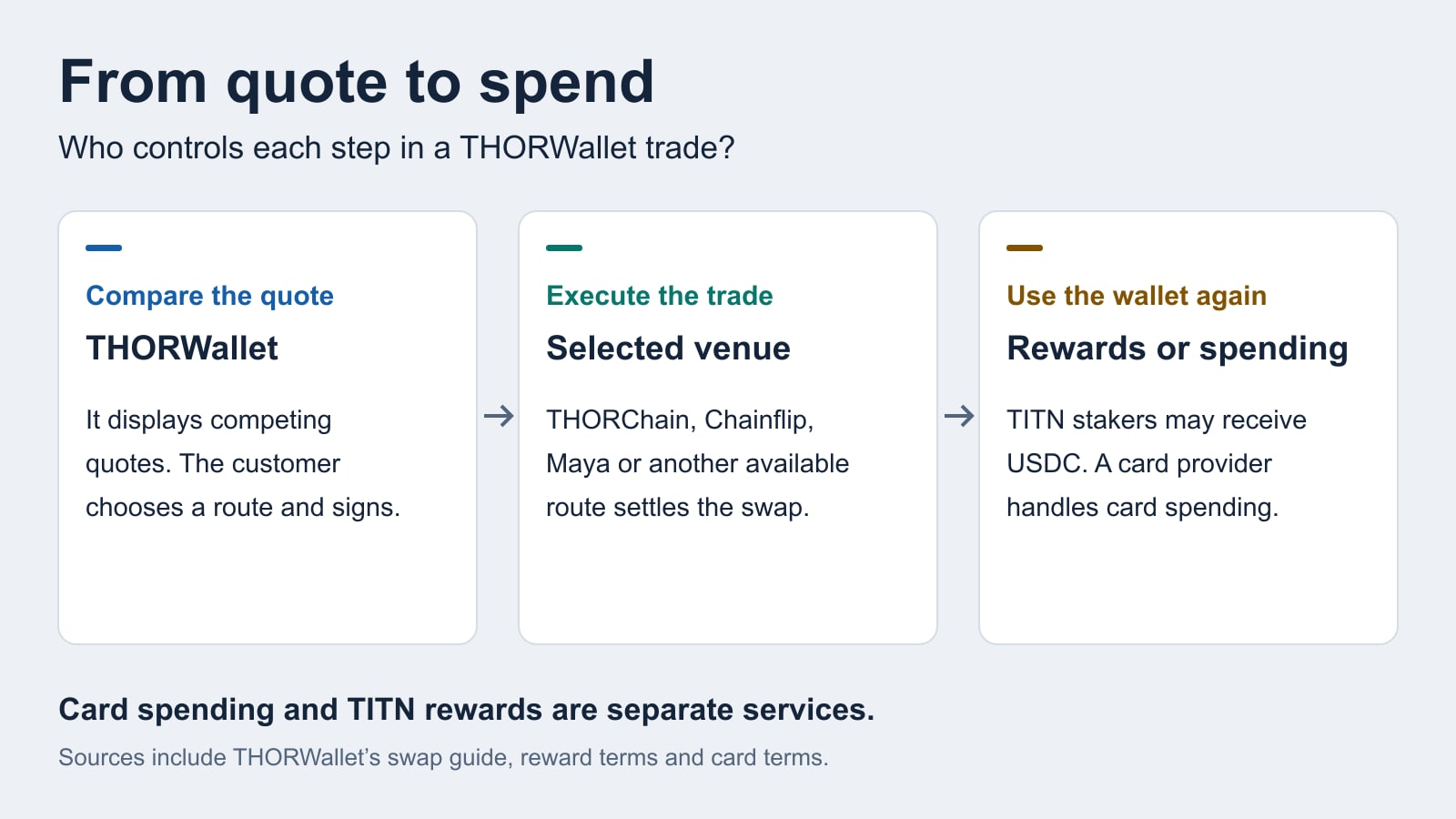
Open THORWallet to exchange native Bitcoin for USDC and, depending on the amount and destination network, you may see quotes from THORChain, Chainflip, Maya or NEAR Intents. You choose a route and sign from your wallet. The selected service carries out the swap. The distinction matters because the company you see in the app and the network responsible for delivering the trade can be different. THORWallet swap routes
The two projects arrived at this transaction from different directions. THORChain began as a research project in 2018 and reached mainnet in 2022. It built a network where users can exchange native assets across blockchains. Its liquidity pools use RUNE, and validators collectively manage the vaults that hold assets used in settlement. THORWallet has operated from Zug since 2021. Its operator, EMM Ventures AG, provides a self-custody interface that brings together third-party trading, lending and payment services. The names suggest a closer relationship than the economics of a particular trade require. THORChain mainnet announcement · THORWallet company background · THORWallet terms
THORChain has to win the trade on price, available liquidity and reliable execution. THORWallet can keep the customer relationship even when another venue wins. That is the commercial advantage of being the place where customers check the price, choose a route and return for the next transaction.
Competing quotes give wallets bargaining power
Chainflip and Maya compete directly with THORChain on native cross-chain swaps. NEAR Intents introduces a different source of competition by having market makers submit competing quotes for a customer’s trade. The useful comparison is specific to the transaction. A route that offers the best net price for a smaller BTC-to-USDC swap may lose on a larger order, on another destination chain or when a network is experiencing delays. Chainflip whitepaper · Maya Protocol documentation · NEAR Intents market-maker documentation
THORWallet faces competition from wallets such as Trust Wallet and Exodus, which also give customers access to swaps from the interface they already use. Trust Wallet illustrates how the roles overlap. It competes with THORWallet for the customer and appears in THORChain’s own affiliate figures as a source of trading flow. Wallets that can direct repeat business have something to bargain with when protocols offer to share fees. THORChain Q3 2026 report · Exodus service terms
There is a reason to look closely at how quotes are presented. THORWallet’s terms allow commercial interests, including affiliate remuneration, to influence how it presents, ranks or routes providers. That makes the net amount delivered more useful than a prominent quote or a low headline fee. For THORChain, the corresponding test is whether sharing fees with distributors generates enough additional business to increase the income left after the distributor is paid. THORWallet terms · THORChain affiliate revenue-sharing proposal
The THORFi default put a claim on future swaps
THORChain’s dependence on trading fees became clearer when its lending and savings products failed in 2025. The lending design could burn RUNE when a loan opened and mint RUNE when a borrower repaid and reclaimed collateral. If RUNE fell against an asset such as Bitcoin, returning the same amount of collateral could require issuing more RUNE. In a wave of loan closures, the pressure from that issuance could weaken RUNE further. THORChain’s unwind report also identified the risk that synthetic-asset exposure would magnify losses for liquidity providers. Original THORFi lending design · THORFi unwind report
The protocol reported roughly $200 million in outstanding obligations across Lending and Savers at the pause. Its response was to issue TCY, with eligible claimants able to claim one token per dollar of recognised liability. Staked TCY collectively receives 10% of system income, paid in RUNE. The original dollar amount determined the token allocation. What claimants can recover depends on the distributions they receive and what they can realise by selling TCY. THORFi unwind report · TCY launch and claim mechanics
That gives an ordinary swap a direct connection to the old lending failure. Part of the income generated by current activity helps fund the restructuring. THORChain now has to win enough business to support that allocation alongside validator incentives, liquidity and development. When a wallet can send the next trade elsewhere, recovery depends in part on how attractive THORChain remains to users who had nothing to do with THORFi. THORChain system income distribution
The Binance theft exposed where intervention is possible
After the October 2026 Binance theft, the FBI specifically urged THORNode operators and other services to block transactions linked to the stolen funds. Independent blockchain analysis subsequently traced some of those assets through THORChain. The tracing identifies the execution network. It does not establish that the trades originated in the THORWallet app. FBI Binance advisory · Bitquery on-chain investigation
THORChain says its protocol lacks a mechanism to selectively block an individual swap. It can pause activity more broadly, as its own May 2026 vault exploit demonstrated. That incident, which THORChain estimated cost about $10.7 million, was followed by a roughly five-week halt. A broad pause can protect the network from further losses, but it also interrupts ordinary trades. Chainflip documents a broker-level ability to flag deposits for rejection, subject to timing limits. The differences become commercially important when a wallet or other distributor chooses which routes it is prepared to offer. THORChain on transaction controls · THORChain Q2 2026 report · Chainflip broker documentation
TITN and card spending extend the relationship beyond the swap
TITN is THORWallet’s token. Its most tangible benefit is that stakers can receive USDC on Base through a pool that may be funded from eligible swap fees. A reward denominated in USDC is easy to compare with the fees a customer has paid. Its value still depends on how much reaches the pool and how much TITN is staked. Older THORWallet materials advertised 70% redistribution. The current terms describe an allocation of up to 70% of eligible fees, and the help pages say payments can vary, fall to zero or be suspended. That leaves the reward as a potential benefit for existing users. The case for adopting the wallet should work without it. Earlier TITN documentation · Current TITN terms · USDC rewards guide
The card gives users a separate reason to return. THORWallet describes a top-up process that can convert supported assets into USDC and credit the card. That is a practical route from crypto held in a wallet to money available for spending. The card provider and its regulated partners handle eligibility, onboarding and payments. A customer can keep control of the assets left in their wallet while relying on a payment provider for the amount they choose to spend. THORWallet card top-up guide · THORWallet card terms
Compare the trade before choosing the wallet
THORWallet deserves a place on the shortlist for people who already use self-custody and regularly swap across chains. Compare the same trade in THORWallet and your current wallet, using the same amount and destination network. Check what reaches your address after fees, which service executes the swap and what its refund process is if the trade cannot complete. If spending is the reason for switching, check the card provider’s eligibility and terms for your country.
That comparison is also the best way to judge where the business is going. THORChain earns its place when customers repeatedly choose its execution. THORWallet earns its place when customers trust it to help them make that choice and find enough value to come back after the trade. The ability to show a better route today is a stronger reason to try the wallet than the prospect of a reward tomorrow.
Sources
Related reading
Commentary ·
Meta, Apple and OpenAI compete to control digital interfaces
Meta, Apple and OpenAI are not competing on devices but across different layers of the interface stack, where distribution, environment and decision control determine how commercial value is captured.
Commentary ·
XRP versus SWIFT in Japan: what determines the cost of settlement?
Claims that XRP is cheaper than SWIFT in Japan reflect a deeper shift in cross-border payments, where settlement speed, liquidity design, and infrastructure control are redefining cost and competitive advantage.
Guides ·
Stablecoins vs SWIFT bank transfers on costs, speed and risk
Compare stablecoin payments with bank transfers using SWIFT, including exchange rates, fees, settlement time and cash-out. A hypothetical £10,000 payment follows both routes to the same bank-account recipient.
Intelligence ·
Polygon’s Coinme acquisition and Samsung Wallet plan widen stablecoin distribution
Polygon Labs has completed its acquisition of Coinme, adding regulated US money-movement infrastructure to its payments stack, while Samsung plans to bring USDC transfers to eligible US Galaxy users. Both moves expand stablecoin access, but neither yet establishes sustained adoption, and each depends on licensed partners, custody arrangements and reliable redemption.