



How Bitcoin ETF flows relate to buying and selling pressure
BlockBeat Guides
Trading existing shares differs from creating or redeeming them. Cash, in-kind transfers and intermediary hedging determine how fund activity reaches bitcoin markets.
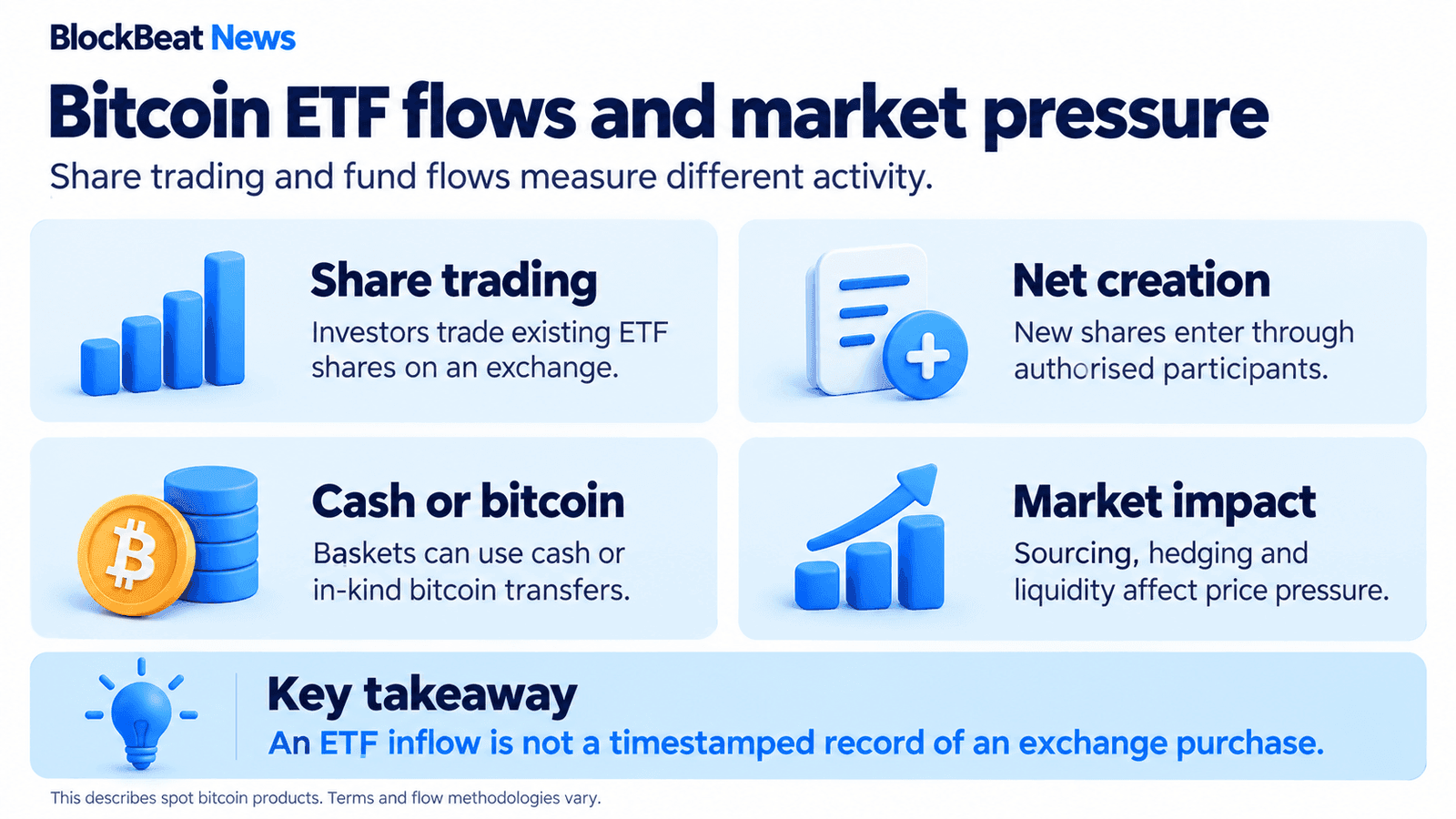
Read the infographic as text
Bitcoin ETF flows and market pressure
Share trading and fund flows measure different activity.
- Share trading
- Investors trade existing ETF shares on an exchange.
- Net creation
- New shares enter through authorised participants.
- Cash or bitcoin
- Baskets can use cash or in-kind bitcoin transfers.
- Market impact
- Sourcing, hedging and liquidity affect price pressure.
Key takeaway: An ETF inflow is not a timestamped record of an exchange purchase.
This describes spot bitcoin products. Terms and flow methodologies vary.
A reported bitcoin ETF inflow can indicate an expansion in a fund's shares, but it is not a timestamped record of bitcoin bought on an exchange. Understanding the connection requires separating share trading, fund creations and the way intermediaries obtain or hedge bitcoin.
This guide concerns spot bitcoin products, commonly called ETFs. Futures-based funds and leveraged products have different mechanics and should not be combined indiscriminately with spot-fund flow figures.
Trading existing shares need not change the fund
An investor can buy ETF shares from another investor or a market maker on an exchange. Money changes hands between those trading parties. That transaction does not itself require the fund to issue shares or increase its bitcoin holdings.
The iShares Bitcoin Trust prospectus distinguishes exchange trading from basket transactions with authorised participants. These are eligible financial intermediaries that can create or redeem large blocks under agreements with the trust. Ordinary shareholders generally exit by selling shares rather than requesting bitcoin from the fund.
Heavy share-trading volume can therefore coexist with little net fund flow. Volume measures turnover; net creations and redemptions measure a different activity.
Creations connect demand with the underlying asset
When demand pushes share prices above the value of the underlying holdings, an intermediary may find it profitable to arrange new shares and sell them. Redemptions can support the reverse trade when shares are cheap relative to holdings. Costs, access and market conditions constrain this arbitrage, so prices need not remain perfectly aligned.
Cash creation involves cash funding the acquisition of the required bitcoin through the product's arrangements. In-kind creation involves delivery of bitcoin in exchange for shares. In-kind redemption transfers bitcoin out against redeemed shares; the recipient can retain, transfer, sell or hedge it.
The SEC permitted in-kind creations and redemptions for specified crypto ETPs in July 2025. Describing all current US spot products as cash-only would therefore be inaccurate. The applicable prospectus and operational terms determine which methods a product and participant can use.
A flow does not identify a single market order
An intermediary delivering bitcoin might use existing inventory, obtain it privately or buy it through several venues. It might hedge before completing the basket transaction. Cash-funded acquisition also need not appear as one public exchange order matching the reported daily flow.
Those routes can create buying or selling pressure, but timing and execution differ. An in-kind transfer can change where bitcoin is held without requiring a simultaneous open-market purchase. A redemption does not prove that all the returned bitcoin was immediately sold.
Consider a hypothetical day with £100 million of creations and £70 million of redemptions across a defined group of funds. Net flow is £30 million, even though gross basket activity is £170 million. Neither number equals exchange share-trading volume. Nor does £30 million establish the size or time of a particular bitcoin purchase.
Read flow figures alongside holdings and methodology
A fund's assets under management can rise because bitcoin appreciates even when no new shares are created. Compare shares outstanding, bitcoin holdings and the methodology behind any estimated cash-value flow. Reporting dates, valuation times, fees and revisions can produce differences between data services.
The IBIT fact sheet's definitions specify reporting conventions for shares outstanding and net assets. Similar-looking dashboard fields may refer to different cut-off times.
Flows also cannot reveal every investor's net exposure: someone can hold ETF shares while shorting derivatives. Price outcomes depend on other demand, available liquidity and hedging. Our guide to crypto liquidations explains another source of urgent market activity. Use flows to understand fund activity, then establish the transmission route before assigning a price move to it.
Sources
Related reading
Intelligence ·
Bitcoin falls below $81,000 as ETF flows reverse
A sharp reversal in exchange-traded fund flows accompanied Bitcoin’s retreat from above $87,000 to below $81,000, while leveraged positions intensified the decline. The latest week shows that regulated access is making crypto more institutionally connected, but not necessarily more stable.
Intelligence ·
Bitcoin slips below $77,000 as ETF outflows weigh on the rebound
Bitcoin failed to hold $80,000 as macro pressure and ETF outflows weighed on the market, while Ether held up better and capital remained selective across major crypto assets.
Intelligence ·
ETF inflows support Bitcoin’s recovery as yields and leverage test the rally
Crypto’s fortnightly recovery was supported by substantial ETF inflows after an abrupt policy and rates-driven reset, while short liquidations amplified the advance. The subsequent retreat below $84,000 shows that regulated demand is cushioning volatility rather than insulating Bitcoin from macroeconomic pressure.
Intelligence ·
Bitcoin’s rally towards $87,000 tracks ETF demand and falling yields
Bitcoin’s advance towards $87,000 has coincided with sustained ETF demand and falling bond yields, indicating that regulated investment vehicles and macroeconomic expectations are increasingly shaping price discovery. The strength remains concentrated in Bitcoin, while leverage and elevated holder profits leave the rally exposed to reversals.