



Crypto's self-custody model has a physical security problem
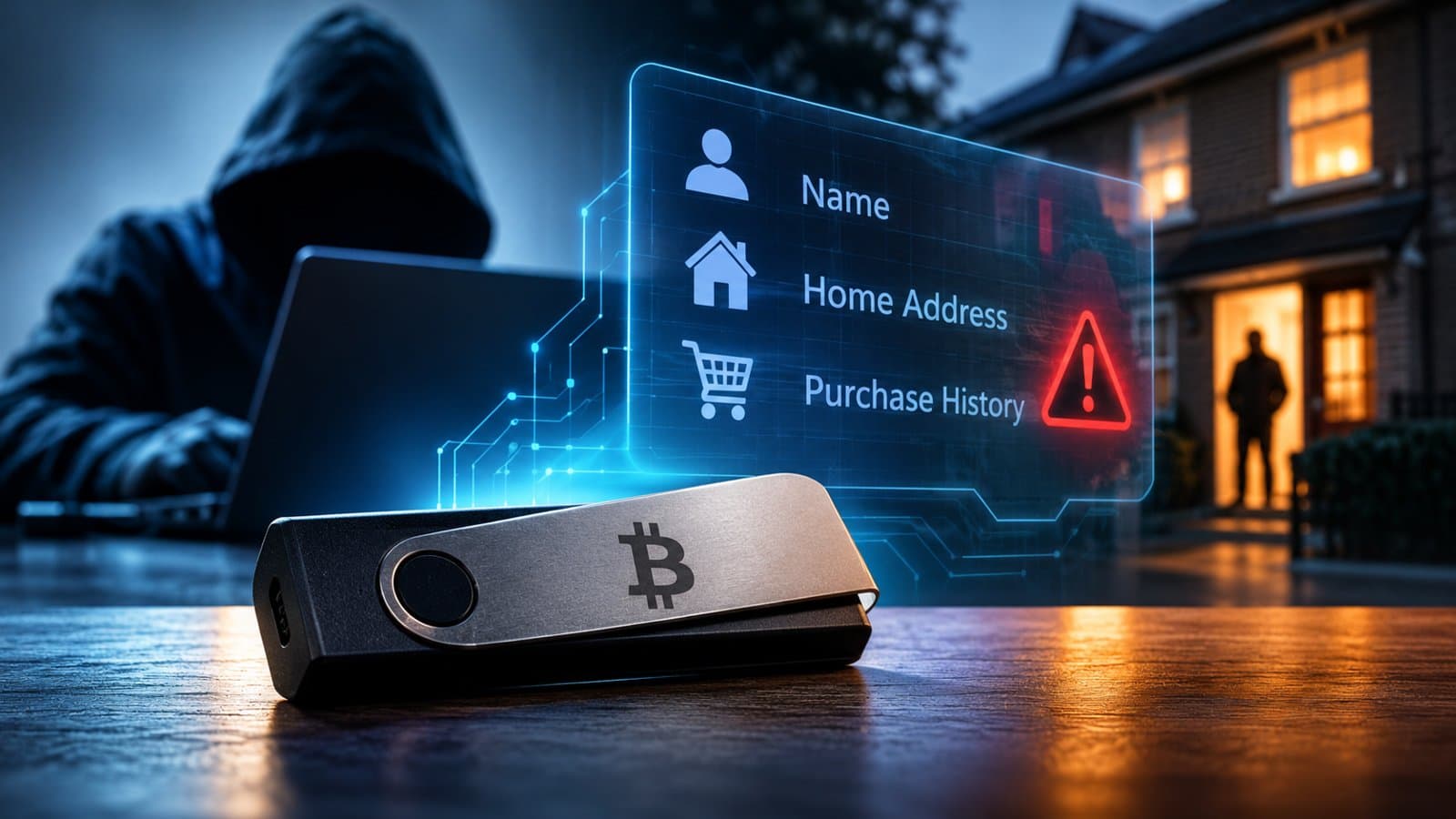
Hardware wallet data exposure and physical attacks on cryptocurrency holders are revealing a structural cost that the self-custody industry has struggled to price. Protecting cryptographic keys does not necessarily protect the identity, location or personal safety of the person controlling them.
The security perimeter extends beyond the device
Self-custody has a clear technical proposition. A user controls the private keys required to authorise transactions, reducing reliance on an exchange or institutional custodian. Hardware wallets strengthen that proposition by keeping signing operations away from ordinary internet-connected devices. Their effectiveness, however, depends on the threat being addressed.
A secure signing device cannot prevent a shipping contractor from exposing a delivery address. Nor can it prevent a customer database from revealing that a particular household purchased cryptocurrency security equipment. Those records do not establish the value of anyone's holdings, and ownership of a hardware wallet does not establish that a person currently holds cryptocurrency. Nevertheless, they can provide useful targeting signals when combined with other information.
This makes privacy across the commercial supply chain part of the security proposition. Manufacturing, payment processing, fulfilment, customer support, analytics and data retention each create opportunities for information to persist outside the wallet manufacturer's direct control. A company can produce an effective security device while operating within an ecosystem that leaves its customers identifiable.
Customer records become a different category of exposure
A leaked retail database usually creates risks of fraud, phishing and account takeover. A dataset linking named individuals and home addresses to cryptocurrency hardware purchases introduces another possible use: identifying people who may control assets that can be transferred quickly and are difficult to recover once sent to an attacker.
The distinction is economic. A name and address become more sensitive when associated with a plausible route to financial assets. Attackers may not need to compromise the device itself if they can pressure its owner into authorising a transfer or disclosing recovery information.
Recent disclosures involving hardware wallet customers illustrate the vulnerability of the surrounding supply chain. The important editorial distinction is that the existence of exposed records and the occurrence of violent attacks do not, on their own, establish that particular breaches caused particular crimes. Any claim of direct causation requires case-specific evidence.
The commercial consequence remains material without that causal claim. Once customers understand that buying a security product can itself generate a lasting identity record, the purchase process becomes part of the risk assessment. Data minimisation, retention limits and fulfilment practices can affect trust as directly as cryptographic specifications.
Physical coercion changes the economics of control
Self-custody places transaction authority with the owner. That independence is attractive because an exchange cannot unilaterally freeze, mismanage or lose assets it does not hold. It also concentrates certain forms of responsibility at the individual level.
In conventional banking, a criminal attempting to obtain a customer's funds may encounter institutional controls, transaction monitoring, account freezes, dispute procedures and opportunities for intervention. These mechanisms vary by institution and jurisdiction, and they do not eliminate fraud. They nevertheless create operational barriers beyond the account holder's immediate control.
For a cryptocurrency holder, a validly signed transaction can move assets irreversibly in practical terms, particularly where the recipient is uncooperative and no intermediary can intervene. That creates a coercion risk which technical resistance to remote hacking cannot fully resolve.
The relevant comparison is therefore not whether self-custody is secure in the abstract. It is which risks the model reduces, which risks it transfers and what those transferred risks cost to manage. A hardware wallet's retail price is only one component of the total cost of protecting significant digital wealth.
The industry's customer acquisition model creates a privacy tension
Hardware wallet companies operate as consumer technology businesses. They acquire customers through advertising, online commerce, distribution partners and repeat sales. Each channel benefits from customer information. Payment records, delivery details, marketing attribution and support histories make sales and service more efficient.
Those same records can undermine the anonymity that some buyers expect from self-custody. The tension is not evidence that manufacturers intentionally compromise customers. It is a conflict between ordinary retail operating practices and an unusually sensitive product category.
Regulatory requirements also matter. Payment, tax, fraud prevention and consumer protection obligations can require businesses to process or retain particular records. Promising complete anonymity would be misleading where lawful recordkeeping still applies.
The strategic response is to minimise avoidable collection, limit retention, reduce unnecessary data sharing and give customers clearer explanations of what remains identifiable. The commercial question is whether manufacturers can make these practices verifiable enough to influence purchasing decisions.
Privacy becomes a product feature with pricing power
Security vendors traditionally compete on supported assets, usability, recovery features, firmware quality, compatibility and price. Supply-chain privacy introduces a further dimension: how little identifying information must be created and retained to purchase, receive and use the product.
This may support differentiated services, including privacy-conscious fulfilment, tighter data deletion policies, independent audits and reduced dependence on third-party customer databases. Such measures carry costs and cannot guarantee anonymity. They may nevertheless become commercially valuable where customers perceive identity exposure as a material risk.
There is a potential margin consequence. Vendors that treat privacy as an operational discipline may face higher fulfilment and compliance costs in the short term, while reducing breach exposure and reputational damage over time. Vendors that continue to treat customer records as ordinary marketing assets risk finding that their data practices weaken the security premium attached to their hardware.
The same logic extends to exchanges and wallet applications. A user can withdraw assets from a centralised platform yet leave behind a durable record linking identity, transactions and wallet addresses. Moving the assets does not necessarily erase the information trail.
Custody providers may regain leverage through risk management
The strongest commercial consequence may emerge outside hardware manufacturing. If holders of substantial assets must account for physical coercion, operational mistakes, recovery planning, inheritance and personal security, specialist custody becomes more attractive for some segments.
Professional custodians can distribute authority across people, locations and approval systems. Multi-signature arrangements, transaction policies, withdrawal delays and institutional governance can reduce reliance on a single person under immediate pressure. These arrangements introduce fees, operational complexity and counterparty exposure. Their value lies in changing the risk profile, not eliminating risk.
That creates an opportunity for regulated custodians, insurers, security providers and wealth managers to package protection as an ongoing service. Revenue may shift towards managed controls, monitoring, recovery procedures and specialist advice, rather than a one-off device purchase.
There is no basis to conclude that physical attacks will force all users into institutional custody. Many holders have modest balances, use appropriate controls and value direct ownership. The more defensible proposition is market segmentation: as holdings and perceived exposure increase, demand for layered security and professional support may rise.
Liability follows the information supply chain
A data incident at a logistics provider raises difficult questions about who bears the commercial and legal consequences. The wallet manufacturer may not have been directly compromised, yet its customers may associate the exposure with the original purchase. Contractors may control parts of the data environment, while consumers have limited visibility over retention and onward transfers.
Data protection law can impose duties on organisations and processors, but the precise responsibilities depend on jurisdiction, contractual arrangements and the facts of each incident. Liability for a subsequent crime is a separate question requiring evidence of causation and the applicable legal standard.
Even where legal liability is uncertain, commercial accountability can be immediate. Manufacturers may face customer support costs, security remediation, reputational damage and pressure to redesign supplier relationships. Procurement and due diligence therefore become part of product security, with consequences for vendor selection and operating margins.
The industry may ultimately need to measure security performance across the entire customer lifecycle, including what happens to personal information after a device has been delivered and a support relationship has ended.
The competitive advantage shifts towards protecting the person
Cryptographic security remains essential. Weak key management can expose funds without any physical interaction, and hardware wallets continue to address an important category of threat. The emerging limitation is that strong cryptography cannot solve every problem created when an identifiable person has unilateral control over transferable wealth.
For manufacturers, the strategic challenge is to reduce the information footprint of ownership while maintaining lawful and workable commerce. For exchanges, it is to recognise that customer identity data can retain sensitivity long after assets leave the platform. For custodians and insurers, it is to develop services that price and manage risks individual users cannot easily absorb.
This creates a new basis for competition across the digital asset security market. The next security premium may depend as much on operational privacy, distributed authority and coercion resistance as on the device that stores a private key.
Self-custody does not cease to be valuable because those costs exist. It becomes a more mature proposition when those costs are recognised and priced. The industry has spent years explaining who controls the keys. Its next commercial test is how effectively it protects the person who controls them.
Sources
Related reading
Commentary ·
Binance and Polymarket put their resources behind customer protection
Reimbursement promises reveal why crypto platforms absorb security losses, and where commercial incentives reach their limits as customer protection.
Intelligence ·
Ledger’s seven-market withdrawal exposes self-custody’s reseller risk
Ledger withdrew wallets from seven Asian markets amid reports that devices sold through reseller CryptoBilis had been tampered with, with estimated losses ranging from $86 million to $93 million. Separate attacks affecting NGRAVE and Electrum users show how wallet security can fail through procurement, authentication and transaction presentation even when the underlying cryptography remains intact.
Intelligence ·
Tokenised bonds and bank deposits move into operating financial products
Tokenised deposits, bonds, private assets and stablecoin payments are moving into operational financial products. Adoption is splitting between institutionally controlled settlement infrastructure and consumer-facing stablecoin services, while security and liquidity risks remain unresolved.
Intelligence ·
Polygon licences and Samsung Wallet plans widen stablecoin distribution
Stablecoins and tokenised assets are moving beyond blockchain-native venues into licensed payment networks, mobile wallets and institutional products. The emerging competitive advantage is distribution and regulatory access, although security and asset integrity remain material constraints.