


What digital provenance can prove about an AI-generated image
BlockBeat Guides
Signed credentials can support claims about an image's origin and editing history. They do not establish that the scene is true, the history complete or publication rights cleared.
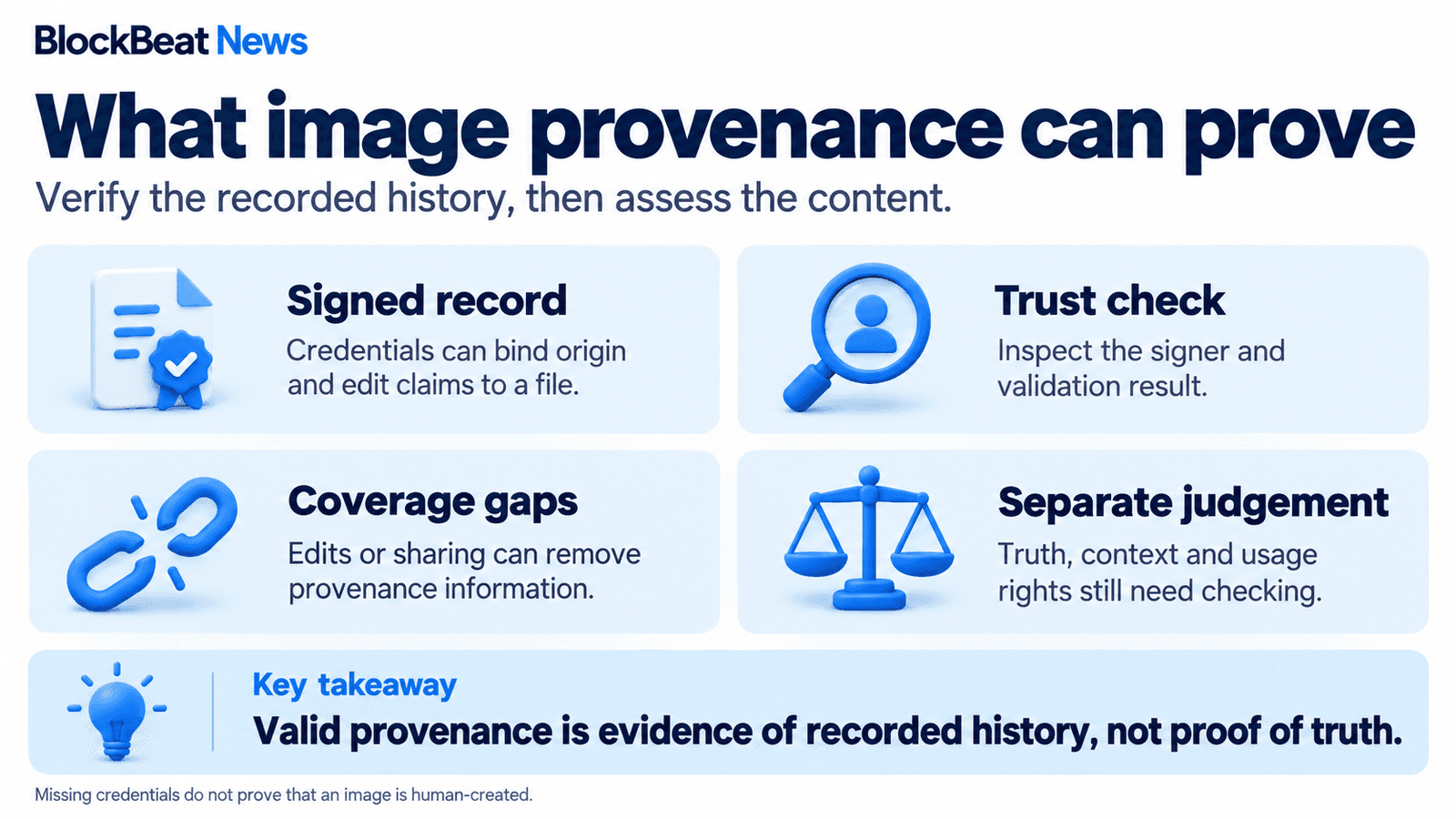
Read the infographic as text
What image provenance can prove
Verify the recorded history, then assess the content.
- Signed record
- Credentials can bind origin and edit claims to a file.
- Trust check
- Inspect the signer and validation result.
- Coverage gaps
- Edits or sharing can remove provenance information.
- Separate judgement
- Truth, context and usage rights still need checking.
Key takeaway: Valid provenance is evidence of recorded history, not proof of truth.
Missing credentials do not prove that an image is human-created.
Digital provenance can provide verifiable evidence about an image's recorded origin and changes. It cannot, on its own, establish that the image depicts a real event or that the person publishing it has every necessary right.
For an editor or marketer, the practical task is to identify which claim a tool has checked. A valid signature, an AI-generation label and a factual verification answer different questions.
Signed credentials bind claims to content
C2PA Content Credentials package provenance assertions with cryptographic signatures and mechanisms that associate them with an asset. Depending on what a participating tool records, those assertions can describe creation software, AI use, edits or source ingredients.
The C2PA explainer describes validation of these records and their relationship to the file. A successful result can support the conclusion that signed information has not been altered in an undetected way within the validated scope. It still matters who signed it and what the assertion actually says.
Imagine a hypothetical image whose credential identifies an AI-generation service, followed by an edit recorded by a publisher. That is evidence of the declared workflow. It does not identify an individual creator unless an applicable, verified identity assertion supplies that information.
A trustworthy record can accompany a misleading image
A genuine photograph can be staged or presented with a false caption. An accurately labelled synthetic image can illustrate a fictional event. Provenance helps assess the source and history; factual verification concerns the depicted claim and context.
Do not convert “credential validated” into “image verified as true”. Examine the signer, the recorded actions and the scope of any identity information. A service signing a file is different from independently witnessing the scene or checking every statement accompanying it.
The NCSC's guidance on selecting provenance systems emphasises the source of trust, extent of the record and strength of the claims. Those are useful questions when a supplier offers a verification badge without explaining the underlying checks.
Missing credentials leave an information gap
Provenance records can be incomplete. Exporting, screenshotting or sharing through a service can remove embedded metadata. A non-participating tool may never attach credentials. Their absence therefore proves neither that an image is human-created nor that it has been manipulated.
The US Office of Research Integrity's provenance guidance distinguishes Content Credentials from watermark detection and cautions against inferring authenticity from absent signals. A tool looking for one provider's watermark is not a universal detector of all synthetic images.
Invisible watermarks, file fingerprints and signed metadata also have different resilience and coverage. Some systems can help rediscover externally stored credentials after transformations. Whether that works depends on the implementation and available record, rather than a guarantee attached to every image.
Copyright and permission require separate checks
A recorded attribution can support an inquiry into where content came from. It does not settle copyright ownership, a licence's scope, a subject's consent or restrictions on a source ingredient. An AI-use declaration is similarly different from permission to publish the result commercially.
For a commissioned image, retain the brief, supplier agreement, original file and relevant usage terms. Compare the provenance with those records. An unexpected signer or missing source ingredient can prompt further checking, but an unexplained gap should not automatically become an accusation.
Preserve the evidence through publication
Keep the original supplied file and inspect it with a compatible viewer. Record the signer, validation outcome and relevant assertions. Check the final published version as well, because image processing and delivery can affect what readers can inspect.
For a news image, verify the depicted event separately. For an illustration, label its purpose clearly and confirm usage permissions. The useful editorial outcome is a documented reason to trust a particular claim about the file, alongside a separate decision about its accuracy, context and suitability for publication.
Sources
Related reading
Commentary ·
Cryptographic provenance could reshape ownership of AI-generated media
As generative systems scale, ownership will no longer be inferred from content itself but enforced through cryptographic provenance layers, redefining monetisation, trust, and distribution across media, marketing, and publishing.
Commentary ·
AI hiring systems are screening CVs written by AI
Artificial intelligence is rapidly reshaping recruitment, creating a feedback loop where AI-generated applications are increasingly screened by automated hiring systems.
Commentary ·
Synthetic training data puts AI reliability at risk
As AI systems increasingly train on synthetic outputs, signal quality degrades and the economic value of authentic human-generated data rises, reshaping media, marketing, and platform economics.
Guides ·
What makes an AI agent different from a chatbot?
The distinction is what the system can do, how it chooses its next step and who authorises the result. A supplier-order example follows the tools, permissions and human checks.