



AI Profits Are Reshaping Labour Power Inside the Semiconductor Industry
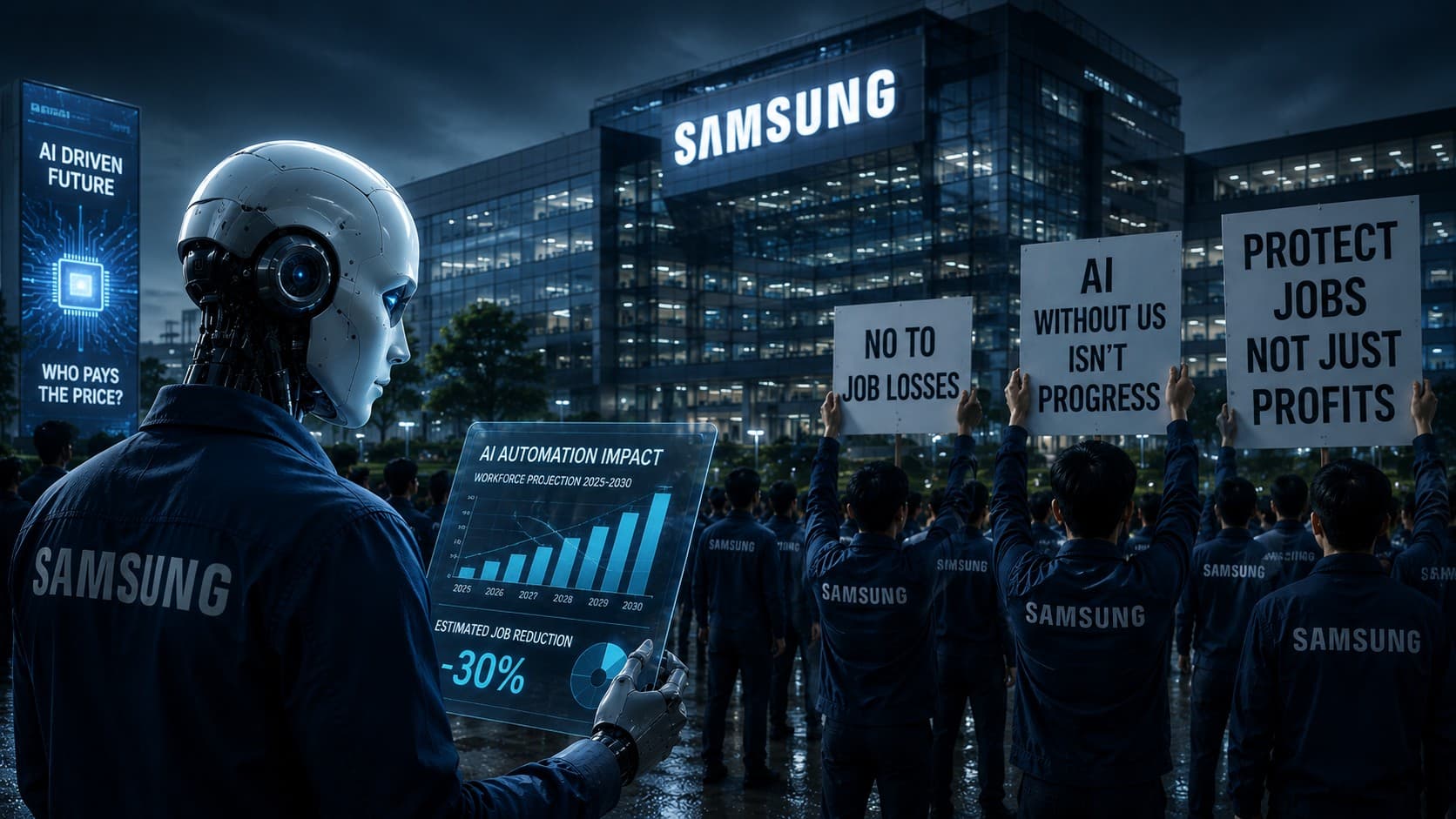
Samsung’s escalating labour dispute is not simply a wage disagreement. It is an early structural conflict over how the economic gains from the AI boom are distributed between capital, labour, and national industrial strategy.
The recent strike threat at Samsung Electronics exposed a tension that will become increasingly common across AI-linked industries. Workers are no longer negotiating against stagnation. They are negotiating against extraordinary profitability driven by artificial intelligence infrastructure demand.
That changes the political and commercial dynamics entirely.
Samsung’s memory and semiconductor divisions sit at the centre of the global AI supply chain. Demand for high-bandwidth memory chips, data centre infrastructure, and AI compute capacity has accelerated earnings across the sector. Investors have benefited materially. Share prices have reflected that optimism. Executive confidence has returned.
Workers are now asking why the upside should remain concentrated.
This dispute is therefore less about one company and more about the emerging economics of AI industrialisation.
AI has changed expectations around profitability
Traditional labour negotiations tend to occur during periods of moderate growth or defensive restructuring. The Samsung dispute emerged during a period of perceived abundance.
Global AI expansion has repositioned semiconductor manufacturers as strategic infrastructure providers rather than cyclical electronics businesses. Governments depend on them for technological competitiveness. Cloud providers depend on them for AI scaling. Markets increasingly price them as long-duration growth assets.
Employees recognise this shift.
The union’s demands around bonus structures and profit participation are tied directly to the belief that AI-related profitability is structural rather than temporary. Workers are effectively arguing that they are participating in an industrial transformation large enough to justify permanent changes in compensation logic.
That matters because it reframes labour from operational cost to strategic stakeholder.
The semiconductor sector is becoming politically sensitive infrastructure
Semiconductors are no longer treated as ordinary manufacturing output.
The AI race between the United States, China, South Korea, and Europe has elevated chip production into a national security issue. Governments subsidise fabrication capacity, intervene in supply chains, and monitor industrial resilience closely.
Samsung sits inside that geopolitical architecture.
A prolonged strike at one of the world’s largest memory producers immediately raises concerns around global supply stability, inflationary pressure on compute infrastructure, and national economic exposure. South Korean officials understood this immediately because Samsung’s performance remains deeply tied to the country’s broader economic position.
This creates a structural asymmetry in labour negotiations.
Workers inside strategically critical industries now understand that disruption carries wider economic consequences than it once did. That knowledge increases bargaining leverage.
AI is concentrating value faster than labour systems can adapt
One of the deeper issues exposed by the Samsung dispute is the speed at which AI-related value is concentrating.
The AI economy disproportionately rewards:
- Compute providers
- Semiconductor manufacturers
- Infrastructure owners
- Data platform operators
These sectors can experience sudden profitability expansion once demand accelerates. Labour frameworks, however, evolve slowly. Bonus structures, compensation models, and productivity assumptions were designed for older industrial cycles.
Workers therefore perceive a widening gap between corporate performance and labour participation.
This is not unique to Samsung.
Across technology industries, employees increasingly view AI-driven profitability as collective output rather than purely shareholder value creation. Whether that perception is economically precise is secondary. Politically and organisationally, it matters.
The conflict exposes a contradiction inside AI capitalism
Much of the AI narrative focuses on productivity gains, automation, and efficiency.
Less attention has been paid to distribution.
If AI dramatically increases corporate profitability while simultaneously reducing labour requirements elsewhere in the economy, workers inside surviving high-value sectors will demand a larger share of gains. The Samsung dispute may therefore represent an early example of labour attempting to renegotiate its position before automation pressures intensify further.
That creates a contradiction.
Companies promote AI as a growth engine while trying to preserve legacy compensation structures designed for lower-margin industrial models.
The two positions become difficult to reconcile once profits expand visibly.
The strategic importance of memory chips changes labour dynamics
Not all technology workers hold equal leverage.
Memory chip manufacturing remains highly specialised, operationally sensitive, and difficult to scale rapidly. Fabrication facilities cannot simply replace experienced workers overnight without risking production quality and throughput consistency.
This gives semiconductor labour a form of structural leverage that many other sectors no longer possess.
The irony is notable.
At the same moment AI threatens to automate broad categories of white-collar work, workers inside physical AI infrastructure supply chains may gain negotiating power precisely because their roles remain difficult to replace quickly.
Investors are now pricing operational stability differently
For markets, the Samsung dispute reveals another issue.
AI-linked valuations increasingly assume uninterrupted production growth. Semiconductor companies are priced not merely on current earnings but on their ability to satisfy future compute demand reliably.
Labour instability therefore becomes a valuation variable.
Investors previously focused heavily on:
- Geopolitical exposure
- Export controls
- Supply chain resilience
- Capacity expansion
Labour relations are now re-entering the equation.
This does not mean markets suddenly become labour-friendly. It means operational continuity acquires greater strategic importance when global AI infrastructure depends on a small number of manufacturing centres.
Governments may become less tolerant of industrial disruption
The response from South Korean authorities was revealing.
Officials reportedly explored extraordinary intervention measures because the economic implications extended beyond a normal corporate dispute. That signals how governments increasingly view AI-linked infrastructure sectors.
This creates another tension.
States want globally competitive AI industries while maintaining social and political stability. Excessive labour suppression risks domestic backlash. Excessive labour power risks economic disruption.
Balancing those pressures becomes harder as AI infrastructure grows more central to national economic planning.
AI wealth distribution is becoming a structural political issue
The broader signal from Samsung is that AI wealth distribution is moving from academic debate into industrial reality.
For several years, AI discussions focused primarily on:
- Innovation
- Capability
- Safety
- Regulation
The next phase will increasingly focus on economic allocation.
Who captures the gains from AI-driven productivity expansion? How much flows to shareholders? How much flows to workers? How much becomes taxable national value?
These questions become unavoidable once AI-linked profits reach visible scale.
The uncomfortable conclusion
The Samsung dispute is not an isolated labour disagreement. It is a preview of a larger economic negotiation emerging around artificial intelligence.
AI is concentrating value rapidly inside strategically important industries. Workers inside those industries increasingly recognise their leverage and are beginning to challenge how gains are distributed.
This creates pressure on corporations, governments, and investors simultaneously.
The AI economy may prove highly productive.
That does not guarantee it will prove socially or politically stable.